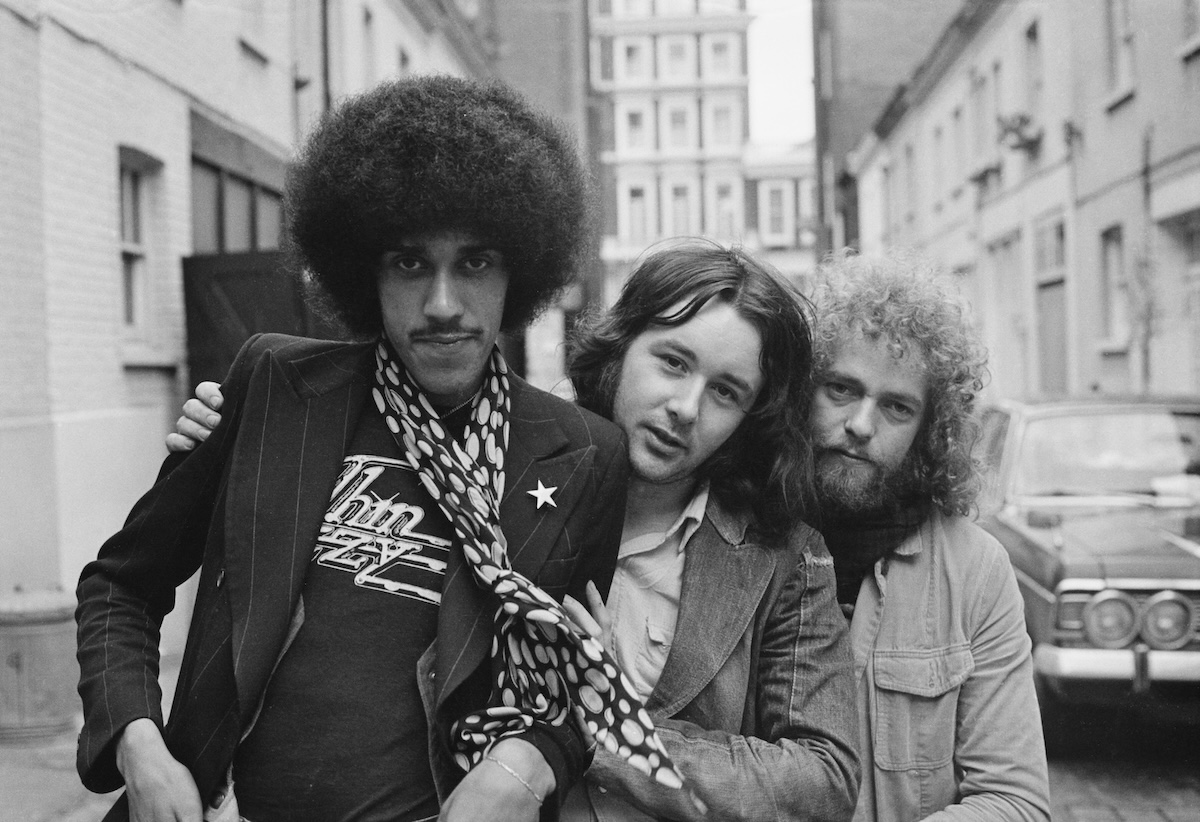
Born in 1949 as the son of an Irish teenager and an Afro-Guyanese immigrant, Philip Parris Lynott was raised by his grandmother in Dublin, where he couldn’t help but stand out as a 6-foot-1 Black man. Taking inspiration from early heroes like Jimi Hendrix and Van Morrison, Lynott began writing folk songs and poetry and playing bass in several local bands, and he formed Thin Lizzy in 1969 with guitarist Eric Bell and Brian Downey.

Lynott and Downey remained the only consistent members of Thin Lizzy after Bell’s departure in 1973, and the band’s rotating lineup became a showcase for some of Ireland and England’s greatest hard rock guitarists as they scored hits like “Whiskey in the Jar,” “The Boys are Back in Town,” “Jailbreak,” and “Dancing in the Moonlight.” Far more popular in the U.K. than in America, Thin Lizzy earned a reputation as a legendary live act, even upstaging bigger bands like Queen and Journey with Lynott’s charismatic command of the audience and the band’s signature “twin lead” guitars.

Phil Lynott died on January 4, 1986 after years of declining health from hard drinking and heroin addiction, 15 years to the day after he began recording Thin Lizzy’s self-titled debut album. In that time, the band made 12 studio albums and two live albums. The longest-tenured guitarist from the band’s original run, Scott Gorham, led a reunited Thin Lizzy from 1996 to 2019, but Lynott remains the irreplaceable, inimitable center of the band’s legacy.
1976’s Jailbreak, featuring career-defining tracks like “The Boys are Back in Town” and “Cowboy Song,” turns 50 on March 26. Is it Thin Lizzy’s greatest album?
14. Chinatown (1980)

Kit Woolven, who’d engineered many Tony Visconti productions for Thin Lizzy and other artists, stepped into the producers’ chair in 1980 for two projects: Lynott’s diverse and adventurous Solo in Soho, and the band’s blandly predictable tenth album Chinatown. Lynott had written two excellent albums in 1976 at his creative peak, but he sounds like he’s tapped out of ideas on rote Chinatown anthems like “Having a Good Time.” “Killer on the Loose” was the band’s last Top 10 hit on the U.K. charts, but Lynott’s playful Jack the Ripper-inspired lyric was derided by the press as tasteless and insensitive at a time when Northern England was being terrorized by Peter Sutcliffe, the “Yorkshire Ripper” who murdered more than a dozen women.
13. Shades of a Blue Orphanage (1972)

Thin Lizzy’s second album was named in homage to Lynott and Downey’s previous band Orphanage and Bell’s band Shades of Blue. The seven-minute title track is one of Lynott’s most lovingly detailed lyrics about Dublin from his folky early compositions. But the band’s sophomore effort was written and recorded quickly on a shoestring budget, and wound up sounding more like a demo than an album, with shaky, tentative performances and dry, lifeless production.
12. Renegade (1981)

Thin Lizzy’s early ‘80s lineup never really gelled, with Pink Floyd touring guitarist Terence Charles “Snowy” White stepping in as a less flashy replacement for Brian Robertson. Lynott also added a fifth member of the band on keyboards, first Midge Ure of Ultravox and then Darren Wharton. Wharton co-wrote Renegade’s best track, the heavy and ominous opener “Angel of Death,” but his dramatic synth arpeggios sound a little more suited to an Emerson, Lake and Palmer album than Thin Lizzy. The eclecticism of Lynott’s solo albums started to bleed into the band’s records, and the jazzy Fats Waller homage “Fats” and the Latin percussion on “Mexican Blood” sound even more out of place. “Only the rousing chorus of ‘Hollywood (Down on Your Luck)’ and the poignant sense of loss in ‘It’s Getting Dangerous’ hint at the sensitive yet anthemic writing and hard-rock smarts that usually separate Thin Lizzy from the lunkheads,” David Fricke wrote in the Rolling Stone review of Renegade.
11. Thin Lizzy (1971)

In 1970, Thin Lizzy signed with Decca Records, the storied London label that helped launch the careers of the Rolling Stones and the Who, but the Irish trio wasn’t quite ready for the spotlight yet. Thin Lizzy’s arena rock future is foreshadowed on “Diddy Levine” and their most Hendrix-influenced early track, “Ray-Gun,” penned by Eric Bell (who, fittingly, would later join The Noel Redding Band). But in those earlier days, Lynott sounded more comfortable on gentler songs like “Honesty is No Excuse,” which features Mellotron by Ivor Raymonde, English session musician and father of future Cocteau Twins bassist Simon Raymonde.
10. Thunder and Lightning (1983)

Thin Lizzy loomed large as an influence on the New Wave of British Heavy Metal, and in 1983 they drafted a guitarist from that scene, John Sykes from Tygers of Pan Tang, who’d go on to multiplatinum success with Whitesnake. “Someday She is Going to Hit Back” is late-period Thin Lizzy at its best, a blistering rocker with an empathetic Lynott lyric about women suffering from domestic violence. Thunder and Lightning was announced as the band’s twelfth and final studio album, and the reflective slow burner “The Sun Goes Down” made an appropriate choice for Thin Lizzy’s last single.
9. Life (1983)

Thin Lizzy embarked on a sold-out farewell tour in support of Thunder and Lightning, releasing a double LP recorded at a London show, along with additional songs from a 1981 Galway concert. With only six of its 19 tracks repeated from 1978’s Live and Dangerous, Life manages to be a worthy if not necessarily essential supplement to the band’s definitive live album that showcases the best songs from their later years. Former Thin Lizzy guitarists Eric Bell, Gary Moore, and Brian Robertson turned up to play at the final shows, and the explosive rendition of “The Rocker” that closes Life is an eight-man all-star jam.
8. Nightlife (1974)

Thin Lizzy’s famous expansion into a quartet with two guitarists was, at least at first, done primarily for practical reasons. After Eric Bell quit and the prodigiously talented Belfast guitarist Gary Moore briefly filled in, Lynott decided to hire two guitarists, Scott Gorham and Brian Robertson, so that the band wouldn’t be caught in the same jam in the future. Moore played on and helped write one song on Nightlife, the album’s consensus classic “Still in Love With You,” which Lynott sang as a duet with Scottish singer Frankie Miller, and which has been covered by Sade, Bobby Tench, and Curt Smith. The rest of Nightlife doesn’t entirely sound like a band’s classic lineup clicking into place, but the combination of Gorham and Robertson throws off some sparks on “It’s Only Money” and “Philomena.” And the influence of the Allman Brothers Band, Thin Lizzy’s most notable precursor in harmonizing lead guitars, is audible on the instrumental “Banshee.”
7. Fighting (1975)

In 1975, Thin Lizzy played some shows in America with Bob Seger, another hard-touring cult hero who was on the verge of a major commercial breakthrough. Entering the studio weeks later, the band recorded a cover of Seger’s “Rosalie” as the opening track and lead single for Fighting. And songs like “Suicide” and “Ballad of a Hard Man” captured the sharper, tougher sound that was making the band a word-of-mouth sensation on the road.
6. Black Rose: A Rock Legend (1979)

Lynott welcomed the punk rock insurgency more readily than some of his rock establishment peers, even teaming up with half of the Sex Pistols for a supergroup called the Greedies that gigged around London and released a hit holiday single in 1979. Black Rose: A Rock Legend, released the same year, didn’t reflect much of any punk influence, though. Instead, Lynott looked to the past to salute Elvis Presley on the opener “Do Anything You Want To,” and weave several traditional Irish songs together on the epic closer “Roisin Dubh (Black Rose): A Rock Legend.” The only Thin Lizzy album recorded entirely with Gary Moore, who’d launched a successful solo career a year earlier, this was the band’s highest charting album in the U.K., where it’s remembered as a classic. Black Rose is less revered in America, where Thin Lizzy’s commercial decline steadily continued and the killer single “Waiting for an Alibi” was sadly ignored.
5. Vagabonds of the Western World (1973)

In late 1972, Thin Lizzy released an electrifying arrangement of the Irish folk song “Whiskey in the Jar” as a non-album single that finally put the band on the charts, climbing into the Top 10 in the U.K. and hitting No. 1 in Ireland. Breaking through with a cover may have put a chip on Lynott’s shoulder, and he sounded like he had something to prove on the band’s next album, penning a confident set of songs that ranged from the enduring anthem “The Rocker” to the beautiful, emotionally complex “Little Girl in Bloom.” Thin Lizzy co-founder Eric Bell shines brightly with flashy slide guitar on “Mama Nature Said” and a dazzling solo on “The Hero and the Madman,” but he struggled with alcoholism and soon suffered a breakdown onstage, leaving the band in the middle of a New Year’s Eve gig at the end of 1973.
4. Johnny the Fox (1976)

Striking while the iron was hot, Thin Lizzy released Johnny the Fox just seven months after Jailbreak. Genesis’s Phil Collins, not yet a household name, stopped by the studio to play some additional percussion, and Thin Lizzy supported the album by playing to some of the biggest crowds of their career as Queen’s opening act in arenas. “Massacre” was later covered by Iron Maiden, and Brian Robertson called Johnny the Fox his favorite of his band’s albums in the 2008 documentary The Thin Lizzy Story. “The lyricism, the sensitivity, that had begun to come through in ‘The Boys [Are Back in Town]’ has been abandoned for — you guessed it — the same kind of heavy blandness, though a wee bit more sophisticated, that everybody from Aerosmith to Kiss has been dishing out of late,” Steve Simels wrote in a pan of Johnny the Fox for Stereo Review.
3. Bad Reputation (1977)

Producer Tony Visconti (David Bowie, T. Rex) was one of the many new converts Thin Lizzy won over with Jailbreak, and he signed on to produce Bad Reputation. The hit single “Dancing in the Moonlight,” with a romantic lyric, fingersnaps, and saxophone from Supertramp’s John Helliwell, is a rare glimpse of Thin Lizzy as a damn good pop band, but it’s an outlier on what’s arguably their heaviest album. The band recorded most of Bad Reputation as a trio after the firing of Brian Robertson, and Scott Gorham cemented his spot as the MVP of all the Thin Lizzy guitarists with his lush multi-tracked performances on the title track and “Southbound.”
2. Live and Dangerous (1978)

Thin Lizzy wanted to record a studio follow-up to Bad Reputation with Visconti in 1978, but the producer only had a couple of weeks available in his schedule. Instead, Lynott and Visconti listened to the recent shows the band had recorded and assembled a double LP that went down in rock history as one of the great live albums of the ’70s. Like many live documents of its time, Live and Dangerous benefitted from plenty of in-studio overdubbing to clean up the imperfections of the soundboard tapes, but the collection endures as an accurate portrait of Thin Lizzy onstage at their pinnacle. A young American musician credited as “Bluesey Huey Lewis” played harmonica on Live and Dangerous’s “Baby Drives Me Crazy” several years before becoming one of the biggest pop stars of the ’80s. Robertson’s solo on “Still in Love With You” and the seamless way “Cowboy Song” transitions into “The Boys Are Back in Town” are just a couple of the many reasons that Live and Dangerous rivals any Thin Lizzy studio album.
1. Jailbreak (1976)

There are woefully far too many people, especially in America, who have never heard a Thin Lizzy song other than “The Boys Are Back in Town.” But you could do far worse for a signature song than that endlessly charming track’s motormouth verses, shoutalong chorus, and irrepressible groove. And anyone who’s been moved to put on the album “Boys” has been greeted with a wealth of other fantastic songs, including the thunderous “Jailbreak,” the swaggering “Cowboy Song,” and the Celtic heavy metal of “Emerald.” Jailbreak isn’t just Thin Lizzy’s finest hour; it’s probably the greatest hard rock album of the 1970s that wasn’t produced by Jimmy Page.