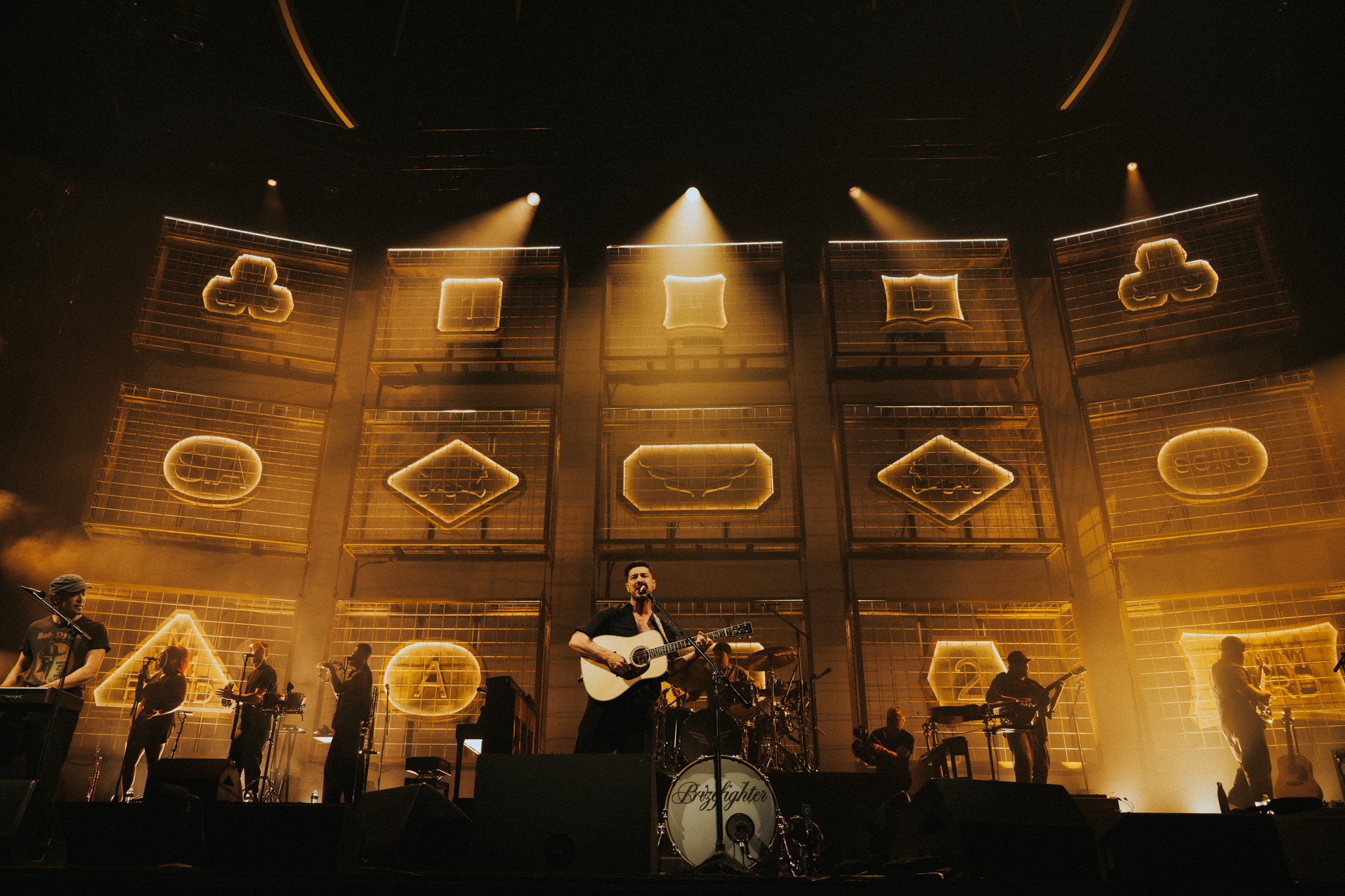
About halfway through Mumford & Sons’ June 6 set at Folsom Field in Boulder, Co., Marcus Mumford paused and took in the view. “Look at this place,” he told the crowd of more than 40,000 gathered beneath the Flatiron Mountans. “This is hallowed ground and we know it. There’s nowhere in the world we’d rather be.”
The sun was setting behind the peaks. The sandstone bowl of a stadium built in 1924 glowed gold. Decked out in cowboy hats, boots and long skirts, college students on summer break stood shoulder-to-shoulder with families, longtime Boulder residents and fans who had traveled across the country. From nearly every seat, the stage shared equal billing with amongst the most dramatic natural backdrops in American live music.
For decades, Folsom Field existed primarily as the home of Colorado Buffaloes football, occasionally hosting major concerts but rarely figuring into the national touring conversation. However, AEG Presents Rocky Mountains and the University of Colorado are pursuing a far more ambitious vision: transforming Boulder into a destination music market anchored by one of the most distinctive stadium concert experiences in the 50 states.

Following Mumford, Grammy-winning electronic trio RÜFÜS DU SOL will bring its largest North American production to Folsom on Aug. 22. Recent years have seen Phish, Dead & Company, ODESZA and John Summit utilize the stadium as a centerpiece attraction. And increasingly, artists are leaving Boulder saying the same thing: why aren’t more people playing here?
Ironically, the current renaissance began after years of relative silence. Many fans remember a notorious Dave Matthews Band concert in 2001 and assume noise concerns or curfews drove major shows away from Folsom. According to AEG Rocky Mountains President Don Strasburg, the reality was far simpler. “The biggest issue was the school went dry,” he says.
Without alcohol sales, large-scale concert economics became increasingly difficult and the venue largely disappeared from the routing map. After 15 years, what changed was a broader shift happening across college campuses nationwide. “The climate and attitude toward alcohol sales on campuses changed,” Strasburg says. “CU agreed to allow sales again.”
Then came an unlikely catalyst. “In 2016, Dead & Company went looking for a creative venue,” Strasburg recalls. “[Manager] Bernie Cahill somehow got Folsom on his radar and we were off to bringing concerts back to Folsom.”
The results have exceeded expectations. Seven concerts landed at the venue in 2024 alone — the busiest stretch since the late 1970s. But bringing concerts back was only part of the story, as one initial challenge was convincing artists that Boulder offered something they couldn’t find elsewhere.
Indeed, the greater Denver area already possesses one of the richest live music ecosystems in North America. Red Rocks remains the industry’s gold standard for outdoor amphitheaters. Denver’s Empower Field handles major stadium business and is the home to the NFL’s Broncos. Coors Field attracts blockbuster tours when the Colorado Rockies aren’t smashing home runs, and AEG’s Mission Ballroom has become one of the country’s premier indoor venues.
So why add another stadium option? Because Boulder isn’t trying to be Denver. “Every one of these venues are phenomenal,” Strasburg says. “Location and feel differentiates them.”
That’s immediately obvious upon arrival. Unlike many modern stadiums built amid parking lots and highway exits, Folsom sits directly inside a functioning college town. Fans spend the afternoon on Pearl Street. They hike. They visit breweries. They wander campus. Then they walk to the show. “It’s a quintessential town and a gateway to the Rockies,” Strasburg offers. That experience increasingly forms the core of AEG’s strategy, which is helping position Boulder as a destination where live music becomes part of a broader cultural experience.

For Mumford & Sons, Colorado in many ways helped legitimize the U.K. trio, whose anachronistic, folk- and bluegrass-leaning music enjoyed a worldwide breakthrough in 2009. Group member Ben Lovett traces the connection back to performing at the Telluride Bluegrass Festival the following year.
“That was the first time that we felt truly accepted playing the music that we were playing,” he says. “We came from the U.K. playing a weird hybrid of folk music and people there really embraced us.” Colorado then quickly became a recurring chapter in the band’s story. Red Rocks runs followed, and music videos like “I’ll Wait” were filmed there. Some of the group’s biggest shows have happened in the state, which made Folsom feel like a natural progression.
“We’ve always enjoyed trying to find less-traveled territory, like when we helped bring concerts back to Forest Hills [in New York] after 16 years,” Lovett adds. “These older multipurpose venues have history and meaning.” Looking out across Folsom on June 6, that history was impossible to miss, as Marcus Mumford repeatedly referenced the band’s connection to the state.
“A lot of these songs began in the state of Colorado,” he told the crowd. “We’ve played some of our favorite ever shows here.” The audience responded accordingly, and when thousands of fans — from elementary school kids to parents singing along beside them — shouted every word of “Little Lion Man,” it felt like one big family reunion.
At another point Mumford joked, “If I have one more person tell me we’re at altitude, I’m gonna blow my shit.” Thankfully, he saved enough energy to rush out into the audience, at one point singing “Ditmas” from in the seats directly opposite the stage and traversing nearly the entire bowl before running back. For the band, the setting elevated everything. Lovett admits, “we’ve been looking back at photos since the show and asking ourselves, did that really happen?”
Indeed, Folsom’s greatest competitive advantage isn’t capacity or a backdrop added to a marketing deck — it’s that view, which is inextricable from Boulder itself. “I wouldn’t have changed a thing about that show,” he says. “Hopefully it leads to more.”
That’s exactly what AEG and the University of Colorado are betting on. The goal isn’t to turn Boulder into a volume-driven concert market but rather a leader in destination events — shows significant enough to attract national audiences while remaining connected to local culture. “It’s really fun and special,” Lovett says. “People can walk there. It feels connected to the community. It feels like it belongs.”

In a touring world increasingly dominated by interchangeable stadiums and identical fan experiences, that may be Folsom Field’s best calling card, because you can’t replicate the Flatirons, nor can you can’t manufacture a century of history. On a perfect June evening in Boulder, with 40,000 people singing into the Colorado sky, those advantages felt impossible to ignore.
“The AEG and University of Colorado operations team work all year to improve every aspect of the experience to make it better and better. If the artist and fan are compelled by the energy and beauty of the space, it sets the landscape for magical shows,” Strasburg says. “I have no doubt more and more people will want to experience Folsom.”