Earlier this summer, our family had the opportunity to visit the Ashmolean Museum in Oxford, England. Among the many treasures there is a skyphos, a large drinking cup or pot with two handles, from the 5th or 4th century BC, that was discovered in Thebes, Greece. A figure is depicted on the ceramic jar, holding a trident and blown by Boreas, the Greek god of the north wind and storms, who pushes him across the waves.
Greek letters identify the man: Odysseus.
By definition, adaptations change things. They often tell us more about those who adapted the material than the original source itself . . .
The legend of this man, who appears in The Iliad and is the focus of The Odyssey—both of which are attributed to Homer and were likely written in the 8th or 7th century BC—has captivated people for nearly three millennia, including those in Thebes.
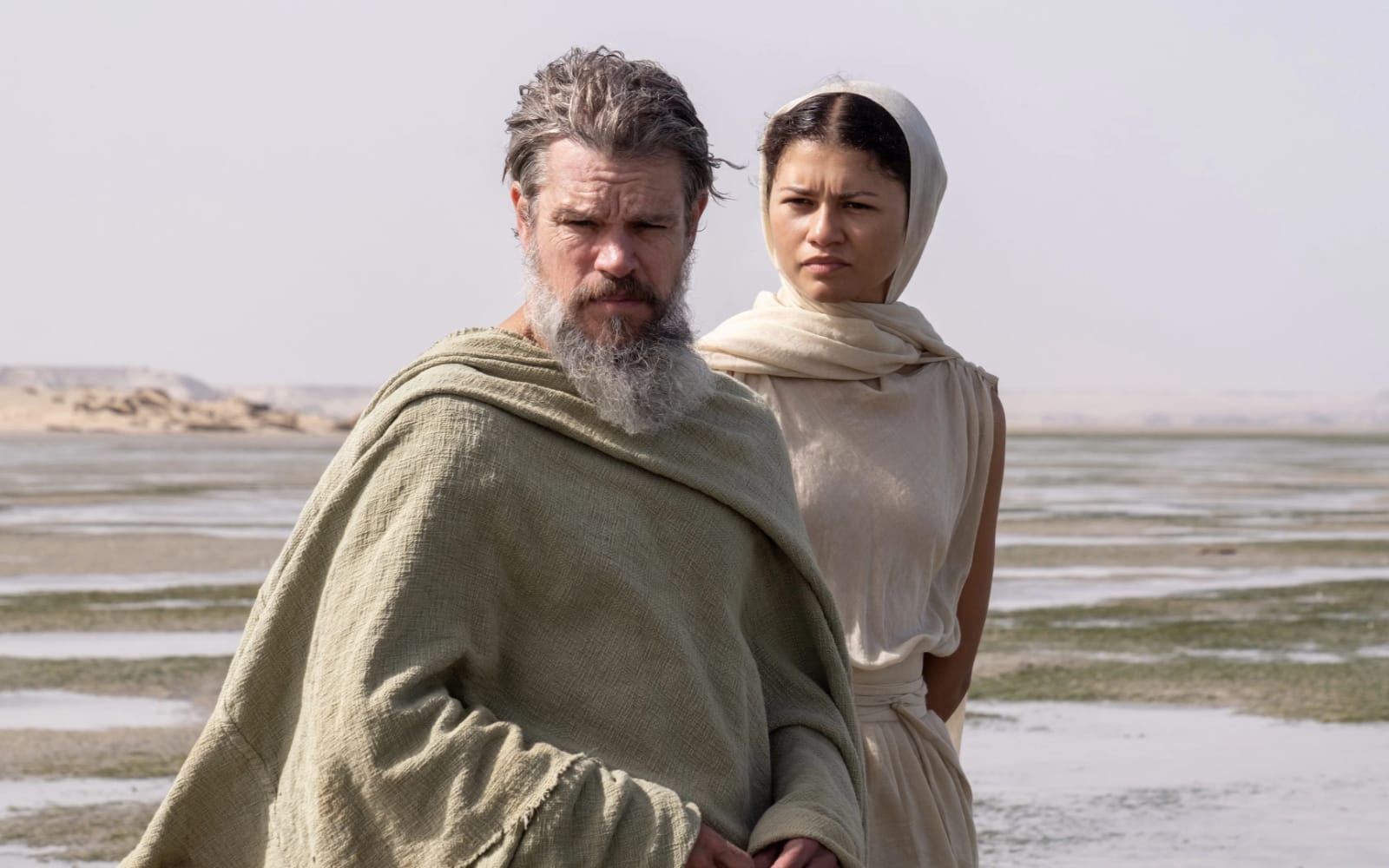
Christopher Nolan is the latest in a long line of artists whose interpretation of The Odyssey has entered the public imagination, though his chosen medium is not a ceramic jar but a camera lens. His film is an incredibly daring achievement, adapting a foundational text of Western literature to just under three hours on screen, shot entirely with IMAX cameras specially designed for the film, and undertaken almost entirely with practical effects rather than CGI.
Nolan gives his audience some of best-known elements of the story: Odysseus (Matt Damon) journeys from his native Ithaca to join his fellow Greeks and lay siege to Troy for ten years, only to be brought into the city through his deception of the wooden horse. But Odysseus’s journey has only begun. He spends another ten years trying to get himself and his men home while encountering dangers and temptations along the way. Meanwhile, waiting back in Ithaca all this time are Odysseus’s wife, Penelope (Anne Hathaway), and their son, Telemachus (Tom Holland), who find themselves under a different kind of siege: suitors vie for her hand and threaten her son, who seeks news of his long-lost father.
Some of the scenes depicted by Nolan—the wooden horse partly buried on the beach, Circe’s grotesque transformation of Odysseus’s men into pigs, his encounter with the dead in Hades—are truly breathtaking. In its most basic elements, film is the recording of gradations of light over time and the arrangement of the resulting images in a compelling way that is then joined to sound. Nolan, whose other works include Oppenheimer, Dunkirk, Interstellar, Inception, and The Dark Knight, has consistently demonstrated his ability to employ those basic elements of film in masterful ways.
But this is not to say that Nolan’s film is necessarily faithful to the text, neutral, or without flaws. By definition, adaptations change things. They often tell us more about those who adapted the material than the original source itself—sometimes reflecting the reality of their time, sometimes showing us how they wish things could be, sometimes warning us of what might come. Adaptations might challenge us, reveal truths about us, or seek to improve us.
Adaptation, it turns out, is also at the heart of the gospel.
Apparent Magic
My introduction to Greek mythology came not through epic poems, but through films featuring the stop-motion effects of Ray Harryhausen: Jason and the Argonauts (1963), which follows a hero’s quest to retrieve the Golden Fleece, and Clash of the Titans (1981), the adventure of Perseus, who beheaded Medusa. It was only later that I discovered Homer for myself. By my recollection, I also saw West Side Story (1961) before reading Romeo and Juliet, but I did eventually find Shakespeare as well.
I expect that Nolan’s film will serve in this role for many, introducing them to a whole world of meaning-making myths. But if they do discover Homer, which I hope they do, they might be surprised, or even disappointed, to find out that the “hero” of the original story isn’t quite who Nolan made him out to be.
Tell me about a complicated man.
That’s how Emily Wilson’s translation of The Odyssey begins. During the 2024-2025 academic year, I read Wilson’s version of Homer’s poem with my students at Wheaton College. Each year, one book is selected as the Core Book, and the whole college community is invited to read the book, engage in communal discussion about it, and take part in on-campus events related to it. (That year’s events included a public reading of the entire poem.)
As my students discovered, in Homer’s poem, Odysseus is not a straightforward hero. Yes, we root for him to make it home, but he is revealed to be cunning, shrewd, and deceitful. Sometimes, he makes sacrifices for his men. At other times, he makes terrible decisions that endanger them or get them killed.
By comparison, in Nolan’s film, Odysseus is guilt-ridden over the consequences of the wooden horse deception and the suffering that it caused—to the inhabitants of Troy and to his entire civilization. This isn’t far off from Jonathan Shay’s book Odysseus in America, which compares his suffering to the PTSD of combat veterans returning home.
Nolan, it seems, wants to make some characters more palatable for his viewers. Would audiences have accepted the Odysseus of Homer’s poem, who doesn’t forget his wife, his son, and his home while trapped on the lush island of Calypso (Charlize Theron), who keeps him as her lover? How would audiences feel about Odysseus rescuing his men from the witch Circe (Samantha Morton) only by sleeping with her, then staying on her island to feast for a whole year before leaving? What would we think of Odysseus when he finally gets home to Penelope, only to tell her almost immediately that he must leave—apparently, without her—on another journey to a place where people do not know the sea and where he will die in peace as foretold by the prophet Tiresias in Hades? Would we accept a hero who not only slaughters the suitors, but also has the female servants who sided with them killed, even if they did so under duress? The adaptations that Nolan has made reflect not only his own sensitivities but also changes in cultural patterns since the time of ancient Greece, many of which we rightly acknowledge as improvements.
Yet there are some elements of the original story that viewers familiar with Homer’s poem will undoubtedly miss: Odysseus’s “no man” trick played on Polyphemus, the Cyclops; the bag of wind opened by Odysseus’s curious men that blows the ship back out to sea when they are nearly home; Penelope’s final test of Odysseus by referring to their marriage bed, a symbol of their faithfulness; and the reunion between father and son when Odysseus sees Laertes again.
But perhaps the most striking difference is that Nolan de-mythologizes the poem in Bultmannian fashion by removing any significant divine intervention. Homer’s Odysseus knows that he inhabits a world of gods and goddesses. In the poem, Athena, goddess of warfare and wisdom, actively aids Odysseus throughout his journey (in fact, she was the one who gave him the idea of the wooden horse) and protects Telemachus as he undertakes his own coming-of-age journey.
The more pressing questions, to my mind, are, Why does this story continue to appeal to us? and What does this latest version say about both the filmmaker and us?
Not so for Nolan. In the film, the role of Athena (Zendaya) is reduced to the point of being a guilty conscience. Hermes, who in Homer’s vision gives Odysseus an antidote to Circe’s potion and orders Calypso to allow Odysseus to leave her island, is kept off screen. Odysseus’s men seem to believe in the law of Zeus and the wrath of Poseidon, but Odysseus tells viewers, “Don’t look for the gods among men. You’ll be disappointed.” This is nothing new for Nolan, who preferred to reveal magic tricks in The Prestige.
As the opening title card for his version of The Odyssey tells us, this all takes place “in a time of apparent magic.”
Odysseus Remade
For some viewers, these changes seem to have been a bridge too far.
In her scathing review of the film, Wilson calls it “a family-friendly audiovisual spectacle, like an elaborate Fourth of July fireworks display—and with about the same level of narrative and emotional depth.” She concludes, “I would be ashamed to have written any part of this script.” This is, at the very least, surprising, coming from someone whose translation has been lauded by Nolan and whose work has benefited so much from the film.
But I find this even more remarkable because Wilson herself knows the challenges of adaptation and acknowledges that translation is its own kind of interpretation. In her introduction to the poem, Wilson confesses, “I have tried to keep to a register that is recognizably speakable and readable, while skirting between the Charybdis of artifice and the Scylla of slang. All modern translations of ancient texts exist in a time, a place, and a language that are entirely alien from those of the original.”
Why should Nolan’s adaptation to screen, which condenses a poem of more than 12,000 lines to three hours, be any different?
If, for some, Nolan’s great sin is that he has strayed at times from the source material and, in the process, given us his own version of The Odyssey, then it is hardly an original sin. Shakespeare, Hugo, the Brontës, Dickens, Dumas, Twain, and many more before and after have all been rendered for a new age. Beloved characters like Peter Pan and Winnie-the-Pooh, (mostly) scorned characters like Frankenstein and Dracula, and complex characters like Gatsby are all reinvented for new readers and viewers.
In the case of The Odyssey, it, too, has been recast through the centuries since it was written nearly 3,000 years ago. For example, Virgil’s Aeneid, written in the 1st century BC, is largely patterned after Homer’s poems, but takes Aeneas, a Trojan mentioned in The Iliad, and casts him as the ancestor of the Romans. Greek myth thus becomes the root of Roman myth, with Virgil displacing Homer.
Roughly 1,300 years later, in the first part of his Divine Comedy, Inferno (or Hell), Dante took it a step further. With Virgil as his guide, Dante discovers Ulysses (the Latinized name for Odysseus) in the eighth circle of hell, placed there for the deception of the wooden horse, among other things. Virgil speaks to Ulysses, who recounts how he led his men astray. In Dorothy Sayers’s translation, Ulysses convinces his fellow Greeks to undertake a voyage into the unknown West with these words:
Think of your breed; for brutish ignorance
Your mettle was not made; you were made men
To follow after knowledge and excellence. (Canto XXVI)
They follow him. After five months at sea, they see a mysterious mountain, later revealed by Dante to be purgatory. But before they can reach it, the ship is wrecked in a whirlwind, and they all drown. Homer didn’t include Odysseus’s death in his poem, so Dante provides one.
It might be surprising that Dante would cast Ulysses in such a light given his virtuous pursuit of knowledge and excellence. Yet for Dante, Odysseus’s deceit eventually catches up with him. As Jason Baxter explains in his introduction to the Divine Comedy, “Ulysses’s end was in some ways the fitting conclusion to his lifelong practice of fraudulence.” Don’t forget that the Romans imagined that their origins traced to Troy. No love lost between the Greeks and Romans apparently.
For his part, Nolan might be borrowing from Dante’s assessment of Odysseus, at least insofar as he deserves punishment for the deception of the wooden horse and the pain that it caused. Or perhaps Nolan is borrowing from Alfred, Lord Tennyson’s poem, “Ulysses” (1833), in which an aging Odysseus is discontented and restless. You’ll find many other renderings of the poem: James Joyce’s Ulysses, a 1922 novel about one day in the life of three Dubliners; the 1954 film starring Kirk Douglas; the Coen brothers’ film O Brother, Where Art Thou? (2000); and The Return, a 2024 film starring Ralph Fiennes and Juliette Binoche (which I’ve written about previously for CaPC). Time and again, Odysseus is remade for new audiences.
It’s helpful to remember that Nolan is no stranger to adaptation as a filmmaker, either.
Most notably, his Dark Knight trilogy gave us an entirely new look to the Batman franchise. Nolan’s Batman, played by Christian Bale, is gritty and rough, though guided by a clear sense of justice. He is, you might say, a complicated man. He wasn’t Tim Burton’s Batman, played by Michael Keaton, and he certainly wasn’t the campier versions played by Adam West, Val Kilmer, or George Clooney. The first installment of that trilogy, Batman Begins (2005), was released in between the first Jason Bourne film, The Bourne Identity (2002), and the first James Bond film featuring Daniel Craig, Casino Royale (2006). It seems that in a post-9/11 context, filmmakers thought that some of our heroes needed remaking.
Adaptation, then, is nothing new, for either Odysseus or Nolan. The more pressing questions, to my mind, are, Why does this story continue to appeal to us? and What does this latest version say about both the filmmaker and us?
The Greatest Adaptation Ever
“adapt,” verb
Root: Latin aptus
Meaning: to make suitable, fit, or apt often by modification
Over the course of his career, Nolan has returned to several themes in his films: the role of memory and time, which often plays out through nonlinear chronology (see his early Memento, the notion of “dreams within dreams” from Inception, and the temporal complexities of Tenet); the emotional bonds of relationships (see the father-daughter dynamic of Interstellar); and the devastating consequences of war (see the tragedies in the midst of rescue in Dunkirk and the reckoning with what humanity is capable of in Oppenheimer).
In each case, The Odyssey seems to have been set up perfectly for Nolan. Much of Homer’s poem is told in flashback, when Odysseus recounts all that has befallen him, including when his men are tempted to eat the fruit in the land of the Lotus-Eaters and forget who they are. Nolan finds the emotional center of the story in the simple account of a man trying to get home to his wife (whose faithfulness allows her to stand in sharp contrast to Clytemnestra, who betrays her husband, Agamemnon) and the son he barely knows.
His adaptation is also suited to our times as he gives us an Odysseus who is grappling with the things that he has done and what he has left undone, seeking redemption and forgiveness, much like the titular character in Oppenheimer. In both movies, Nolan asks us to look with open eyes at the wages of war—one from recent history, one from the imagined past.
In a sense, this film might serve as a warning: This is what could happen—perhaps what is already happening—to our society. This is what happens when we forget how to treat strangers, the importance of hospitality, and not taking advantage of other’s hospitality. This is what happens when we fail to take responsibly for the duties that are given to us, as in the case of Antinous (Robert Pattinson), who buys his way out of military service by convincing Sinon to take his place. In this film, destruction comes not through an atomic weapon but through the erosion of love for the other. Alissa Wilkinson suggests that, across his films, Nolan wants us to consider the ways that we are connected to others: “We’re linked to one another in what we owe each other — those bonds that are sacred, and that once broken are hard to mend. And we’re linked to those in the past and future as well: What we do now echoes our ancestors and has consequences for our descendants.”
Such themes should appeal to Christian viewers.
God’s condescension to humanity by taking on flesh in the person of Jesus Christ, by becoming truly human in order to redeem humanity, is the greatest “adaptation” ever.
After all, Scripture is full of commands to care for the foreigner and the stranger (Lev. 19:33-34; Matt. 25:34-36; Heb. 13:2), to love both God and neighbor (Matt. 22:34-40), and to hand on the things of “first importance” to the next generation (1 Cor. 15:3-8). Nolan’s version of Zeus’s law, the moral center of the film—treat others the way you want to be treated—echoes Jesus’s own words (Matt. 7:12).
But do we hear these echoes when they are found in unexpected places?
The Theology and Film class that I teach at Wheaton College includes some challenging films by directors who make their viewers work: Kurosawa, Tarkovsky, Malick. This isn’t the class for The Avengers. But I soon discovered that often the most difficult film of the semester for my students is whichever adaptation of the gospel message I decide to screen.
These films aren’t difficult for the students because they don’t know the material, but rather because they do. They might not be sure what to make of Malick’s The Tree of Life, at least not on the first viewing, but they’re certain that the Jesus in their Bible doesn’t look like the Jesus in Godspell or say and do some of the things that Willem Dafoe says and does in Scorsese’s The Last Temptation of Christ.
Adaptations can challenge our assumptions and expectations. They might also open our eyes to new possibilities or point us in the right direction.
Indeed, some see foreshadows of the gospel in Odysseus’s story: the suffering of a man sent on a mission, the homecoming of a son, the return of the rightful king. In From Achilles to Christ, Louis Markos also points to, among other things, the Christ-like self-emptying that Odysseus undertakes in disguising himself as a beggar when he returns to Ithaca and the righteous judgment day that he enacts on the suitors.
Yet as Christians we know that this story—in whatever adaptation you choose—will not ultimately satisfy. Something is missing. In Christians Reading Classics, Nadya Williams writes, “Reading the Homeric epics as Christians, we can see a God-shaped void—a yearning for something greater than what the Greek bards and their audiences could ever see here on earth.”
During our family’s time in Oxford this summer, in addition to visiting the Ashmolean Museum, we also toured the Kilns, C. S. Lewis’s home from 1930 until his death in 1963. Lewis was known to have enjoyed Norse mythology, which captivated his imagination. Yet, he too found that something was missing in these stories that he loved so much. It is perhaps not surprising, then, that his conversion to Christianity included his recognition that in the case of Jesus, myth—the myth of the dying god, the myth of a promised eternal life—became fact. As Lewis explains in one of his essays, it is not in an imagined past, but in this historical person, that all of our longings and hopes are fulfilled.
Nolan’s version of The Odyssey gives us a visually stunning adaptation of one man’s journey, suited to the concerns and questions of our time. What we truly need, though, is not just an adaptation of an old story, but a new story.
God’s condescension to humanity by taking on flesh in the person of Jesus Christ, by becoming truly human in order to redeem humanity, is the greatest “adaptation” ever. In the incarnation of Christ, the eternal Word and Son of God is “made fit,” in a sense, to enter into the world, suited to achieve our reconciliation with God. “In the past,” writes the author of Hebrews, “God spoke to our ancestors through the prophets at many times and in various ways, but in these last days he has spoken to us by his Son.” (Heb. 1:1-2). By becoming truly human in Jesus Christ, God adapts or accommodates God’s very self to our situation. And by dying on the cross and rising again, God then makes our adaptation possible. For in Christ, we undergo our own transformation. We are changed, made a “new creation” (2 Cor. 5:17). By God’s grace, we are “made fit” to enter into the presence of the triune God.
The gospel is not the story of a complicated, cunning man. It is the story of one man—the only one—who is fully human and fully divine, who adapted himself to our situation, even though it took him to a distant country, and who then helps us find our way home.
Nolan’s Odysseus warns us, “Don’t look for the gods among men. You’ll be disappointed.” But in Christ, we find God as man. And we are not disappointed.