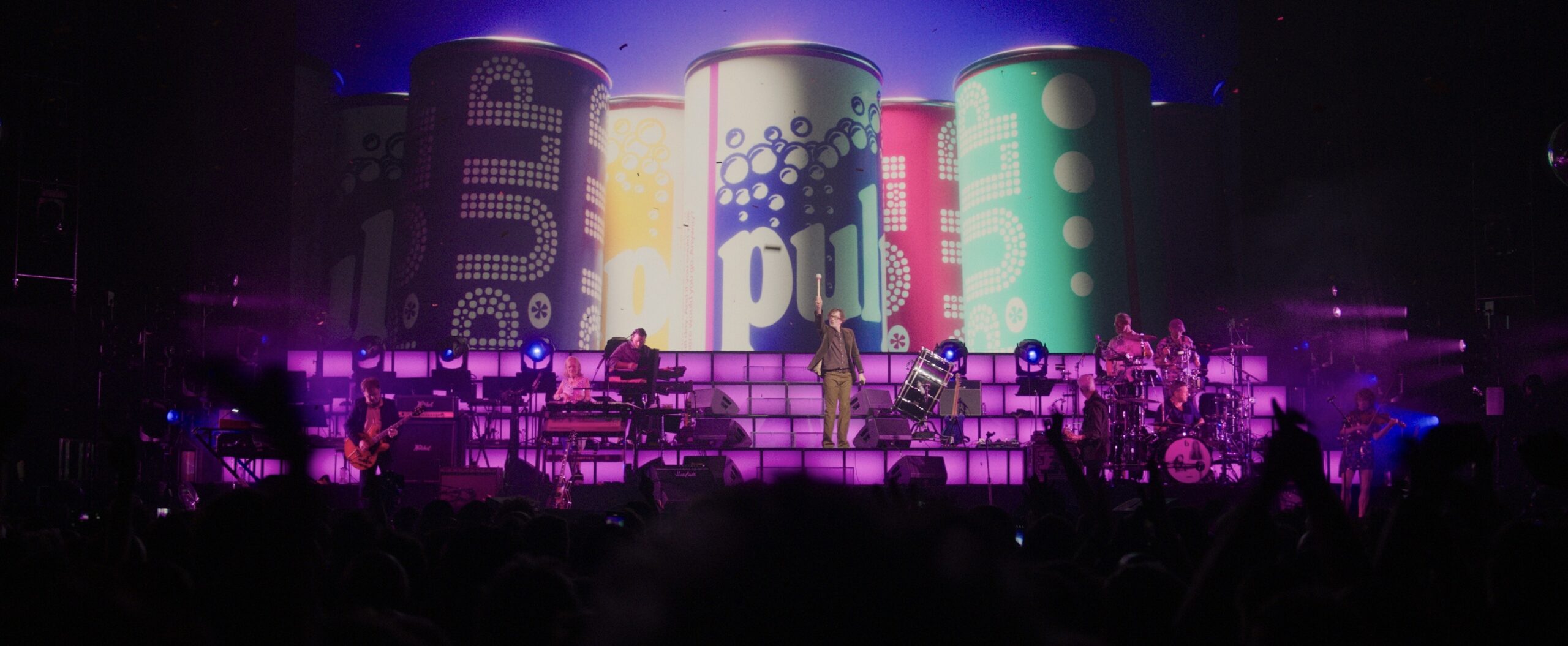
Pulp’s second distinct comeback has already produced a new album, a triumphant return to the stage and a fresh chapter in the band’s long, singular story. It’s now bound for the big screen in the form of Pulp: What Do You Do for an Encore?, a feature-length documentary directed by Garth Jennings premiering on MUBI Sept. 25 and screening the day before in theaters worldwide.
Part concert film, part archival time capsule, the 90-minute project captures Pulp’s elaborate arena production during the tour behind More, the band’s first album in 24 years. Narrated by frontman Jarvis Cocker, it features 20 songs alongside four decades of previously unseen footage, tracing the group’s evolution from Sheffield, U.K., outsiders to one of Britain’s most distinctive and enduring bands.
Formed in 1978 when Cocker and original guitarist Peter Dalton were teenagers, the beloved U.K. outfit released seven albums during its initial classic era from 1983 to 2001, including the 1995 masterpiece Different Class. Pulp split in 2002 but reformed as a touring entity between 2011-2013 before disappearing for another decade.
Jennings, whose credits include Son of Rambow, The Hitchhiker’s Guide to the Galaxy and the Sing films, first worked with Pulp on the 1997 video for “Help the Aged” and again the following year on a clip for “A Little Soul.” When he heard rumors of the band’s reunion in 2022, he reached out to Cocker on a whim. That impulse eventually led him to direct both Pulp’s live shows and the documentary itself. But the project did not come together without setbacks. An initial attempt to film the reunion shows in 2023 collapsed when financing fell apart, only to be revived after Pulp recorded More. For Jennings, the disruption ultimately improved the film — and reinforced the larger emotional meaning of the band’s return. “I did it because I love them,” he tells SPIN. “And I’m really glad I did it.”
In the conversation below, Cocker and Jennings discuss Pulp’s unusual combination of precision and spontaneity, the theatrical ambition behind the band’s latest live production, the importance of each member’s individual personality and the joy of watching musicians who no longer feel the need to prove anything.
Pulp fans have been waiting for something like this for a long time. Was it ever discussed before?
Garth Jennings: No, no one came and asked me to do it. It was my own silly thought in 2022 texting Jarv and saying, oh, I hear you might tour again. That would be great. And if you want me to film it, I’d give it a shot. I’ve never done it before, but I’m sure it’d be fine. And then I ended up getting asked to direct the actual live show itself. And then we try and shoot it in ’23, the financing falls apart and the whole thing falls apart. Oh, what a shame. It’s such a great show. But we found some new financing and they came out with a new album, and the whole thing just became much better as a result of falling apart. It was a beautiful ending to the process. I’ve done so little in my life that was planned. Once I’m making something, I’m very specific, but things come and go and fall apart all the time. When it works out, it’s a beautiful thing. I just love them. There was no reason to make this and I was in the middle of another project anyway. It was crazy to do it at the same time. But I did it because I love them, and I’m really glad I did it.
Jarvis Cocker: To be honest with you, it wasn’t my idea to [include archival material]. I thought that we were just going to make a concert film. And then Garth said, well, I’ve decided to put some archive stuff. I guess I just took a deep breath and thought, OK, so really what this film is going to be like is, there’ll be certain sections that will be like I’m dying and I’m seeing my life flash before my eyes. Maybe that’s good practice before I actually do die.
We were touring anyway, so Garth was getting on with the film and I think we finally got to see a rough cut of it probably just before Christmas last year. It was a strange experience. For instance, there are some clips that’ve got my mother and my grandmother in it, and both of them have passed away. Garth is a fan of Pulp anyway, so I think that helped a lot because he chose the archive in a very kind of sensitive way. He’d also had taken quite a lot of stuff from the book that I wrote about four years ago. That’s a long way to be saying, it wasn’t my idea. I guess it kind of means that the film also acts as an introduction to Pulp for people who don’t know us. That was something that I noticed from the concerts — a lot of young people came to see us. I was very happy about that. I suppose they weren’t born when Pulp first started, so they can catch up now.
You’ve worked with the band in various forms in the past, but what was your own path to experiencing Pulp’s music?
Jennings: I love that I discovered them on John Peel’s Festive Fifty. I thought they were the greatest thing ever. There was a song, ‘Razzmatazz,’ that absolutely lit me up like a Christmas tree. And I just had never seen anyone like him either. I mean, I love the songs. But when I saw him perform, I’m like, what is this? This is just the greatest thing ever. And this sort of showmanship. I’d grown up loving people like Freddie Mercury or Sammy Davis Jr., who never left anything. They put it all on the stage. And now there’s this guy, and there’s no stopping him. He’s just so engaging. From the outset, I loved them. What’s been so nice is realizing that I love them even more now, even though there’s a different reason. No one’s trying to prove themselves or kickstart something or reinvigorate something. They’re doing it because they love it and, the people want it.
Pulp went away for long periods of time before these more recent comebacks, but the vitality that is inherent to this era of the band really comes through in the movie. How have they evolved as people in the time since you first crossed paths with them?
Jennings: Jarvis and [late bassist] Steve [Mackey] were the people I would talk with most when we were doing those two music videos. They were so specific and smart and knew exactly what they wanted. This was when they were just about to release [the album] This Is Hardcore. I didn’t know them intimately as friends — I only knew them as people I was working with. From the outside, it was like, this is a band trying to do something new and change what they did before. But the difference between that energy and now is remarkable, because there’s still that specificity. There’s still that vision. They all know if it works. But now, the motivation seems to be, let’s do it because it’s wonderful. No one asked me to make this film — I just threw myself into it. And it feels like no one asked them to make an album. There’s something liberating about being at this stage where you don’t have to prove yourself or compete against other bands. From my outsider point of view, that’s the biggest difference.
You get a sense of that with how the live performances are staged, in ways that are not necessarily common to Pulp’s usual concerts.
Jennings: No, it’s gloriously like, let’s go for it. It started with the idea of, let’s have a beautiful big velvet curtain, and you’re going to come out and be revealed and you’re going to come up on a riser and there’ll be a string section, and let’s celebrate it. There’s a theatricality and embracing of that showmanship that maybe could have happened years ago, but it certainly feels right now to go, ta-da! It’s really lovely to see. I mean, there’s not many people who know how to come into a show on a riser with some cardboard cutouts. I’d say, it’d be really great if by this part of the song you were at the top step, but then I figured he’d forget about it. But no, two hours later in rehearsal, he absolutely nailed it and arrived at just the right point. He knows where to be, all the time.
That’s a great point, because there is something about Pulp that is effortlessly cool and in the moment. But the movie shows you how deeply the band, and Jarvis particularly, care about the presentation. This is not something thrown together. He spent years even just preparing as a human to be in a band in the first place.
Jennings: Isn’t that great? It’s like that thing you hear about sports people who already know the shot they’re going to play, because they’ve thought about it and thought about it and thought about it. When they turn up, they just kind of go, whatever, you know, and you go, wow, that guy’s amazing. It’s like, no, that guy was absolutely thinking about that moment for years. But you’re right: no visual or sonic element is by chance. It’s all wired in. I love seeing somebody in their element and at their best, and I certainly felt like that when filming these shows. It was a beautiful thing to watch.
Is there a highlight or two from this process or perhaps an example of something that started in one direction and wound up going very far elsewhere?
Jennings: There’s so many examples. The first day that Jarvis came in to talk to me about the show, he was like, I’m thinking about flying into the show. How do I fly into it? How could I do that? I realized, oh, ok, we’re going big with this. Right. You want actually your body to be flown in on a wire or something. I went as far as to find a gymnast who would be dressed like Jarvis that we could catapult into the arena. Their manager wisely said, please don’t put anyone on wires. But that was a window into the ambition that Jarvis had for the show. Like, let’s make an entrance. Let’s have some fun with this. One of the big highlights was one of the quietest, which was recording the voiceover at the end. It was literally the last piece of the puzzle. We had temp voiceover and it sounded fine, but the very last night, Jarvis tweaked his script in some places and came in the next day. We did the whole thing and it was magic. Suddenly, all this stuff blended beautifully. This voice was telling me a story and he’d added these little pieces that meant the world.

What do you think this film really demonstrates about how unique this band is and its contributions to music over the past 40-plus years?
Jennings: They are a very special band. Well, my ambition was to really make it so that it wasn’t just for fans and could have a really broad appeal. If you’d never heard of them and someone made you watch this film, that hopefully by the end of it, you were in love with them. The music is great. The performance is great. But when you also learn the story behind it, those songs take on even more meaning and value. Jarvis has been on a journey from a little kid in his front room at Christmas with a Dalek from Doctor Who all the way to now being a man in his 60s having the night of his life. I think that that is infectious. Beyond just loving the music, it’s a hopeful story for all of us, to keep finding things we love.
Cocker: Without sounding kind of gushy or whatever, the audience is what makes concerts happen. You could hire a big venue and you could rehearse there and make a noise, but when an audience is there, it’s like a chemical reaction happening. You need two things that react together, and if you pull them into the same glass, then it’ll start to move. Then something will happen, and that’s what happens at a great concert. You go out, you play a song and then you feel how people are reacting to it and that inspires you to put more into your performance, which makes people react more. I’ve even discovered recently that there’s a technical term for this thing, and it’s collective effervescence. It was coined by a French psychiatrist, I think in 1912. I’m always very curious about the audience. I wonder how they got there and why all these individual people become this mass that then makes a magic thing happen. I hope that the film captures it. It’s best to actually be there and be part of it, but I’m glad the chemical reaction still happens.
Jarvis is still finding very deep personal things to write about. It’s awesome that the film showcases older material and the hits people know, but you also get a very nice sampling of the current music.
Jennings: It’s true, and they’re still so curious, even outside of their own work. Jarvis has been working as a Booker Prize judge and reads 25 books in a month. It must be lovely to have that relaxing feeling of, we just do it because we want to do it. It’s not like, we’ve got to beat that last album. That’s gone, and it’s just pure joy. Like he says in the documentary, you can’t force it. It’s either there or it’s not, and it was there. They recorded the album in like three weeks, which is a record for them.
Obviously Jarvis is the focal point of Pulp, and you get to see excerpts from one of his childhood notebooks, but the other members are very unique and distinctive in their own right.
Cocker: I think [the notebook] would have been done probably when I was about 13 or 14 and I was really wanting to be in a band. But I was a shy child, so it was easier for me at that point to write it out in a book and say, this is what is going to happen, rather than going and asking people if they would be in a band with me. I planned it out in my head, but I think I say in the film at some point [that] I’m really glad that it didn’t follow a master plan. Once you get other people involved with you when you try to write music with them, you’re not in control of it anymore. It started at school, so it was really just friends who weren’t into playing sport and didn’t really have any other kind of social activities. I managed to get them to come to my mother’s house on a Friday night. The first rehearsal that we had, I bribed people. I got cans of lager and I said, OK, if you’d come to the rehearsal, you’d be able to drink some lager as well. That part of the rehearsals disappeared fairly quickly because it was not very productive. People just got drunk and didn’t actually play their instruments.
I’d wanted to be in a band since probably about the age of seven. The Beatles were number one the day I was born and had that effect worldwide. They were normal people and they were the first band that wrote their own songs. It was a big inspiration, like, you could do that as well. I was seven when they split up. Maybe I just thought, OK, they’ve gone now [and] I can take over. The idea didn’t ever leave me, really. I’m very lucky to actually realize what was really a very unrealistic childhood ambition. Lots of kids want to be a fireman or a spaceman. I wanted to be a pop star and I actually managed to do it.
Jennings: One of the things I loved that I hadn’t seen until we were editing the film was when Mark Webber was painting his nails. He says, well, everyone else has these nice clothes and I’m not really into clothes, so I thought I’d just paint my nails, but the trouble is, I keep flooding my cuticles. I thought, wow. That is the most beautiful distillation of that young man at the time, like, they’re all looking nice, but I’m just gonna do this, and I’m not even that good at it. They’re an eclectic mix of people, like [keyboardist] Candida [Doyle] arriving on stage every night with her glass of champagne. She’s always dressed beautifully. Everyone has their own little world on stage, and even though they’re perfectly in sync, there’s a sense of these very different characters. You realize just how important those personalities are and what they bring to it all. Watching them rehearse up close, you see how each one of them is brilliant and vital. It’s almost like a chemical reaction. The way they look at each other, watch each other and feed off each other is very special.

Were there any films or directors that informed how you eventually approached putting this all together?
Jennings: This really started when we were designing the live show. Jarvis and I had just seen ABBA Voyage in London, and we loved it. Honestly, I’ve seen it three times. The joy of it is so infectious. We wanted something that was so unapologetically celebratory. It wasn’t about the aesthetics — it was about the spirit. He wanted to make an entrance, so we started thinking about a glass staircase. Jarvis has this incredible silhouette and very unique physique. Especially with those tailored suits, it was like, let’s create something where you pop. We didn’t want that thing where you look at these fun visuals over here and the singer is over there, so your attention is split. We wanted everything to serve the band, which started to inform how we filmed it.
When it came to the archive stuff, it was just gold. If you’ve ever gone through your own photographs, you know how you just get lost. We found bits of Jarvis in some interview that no one’s ever seen before, and his voice had changed, so it’s like, listen to that different person. There’s real poignancy to these young people saying, I don’t know where this is going to go. Maybe this is the last album. Now we can look back and realize, wow. He had no idea where his life was going. Isn’t that lovely?
Cocker: I’d just seen the ABBA Voyage thing and it turned out that he’d watched it three times, so he was very into it. The main thing about that show is, you think, how do they make the figures look real and all that? What I liked about the show was that it was a mixture of things. It wasn’t just like looking at a video screen. The band were real people playing and it seemed like a new way of presenting a pop show. We didn’t steal any ideas. I don’t want to get sued by ABBA (laughs).
Now that Pulp has stopped touring, I have said that we will all go on a group visit to the ABBA show as our kind of end of tour party. I think we’re going to do that sometime in October. There were some parts of the ABBA show where they just had images on the screen behind and the avatars disappeared. As soon as that happened, you felt the audience’s involvement there dwindled. So in a weird way, it made me realize that the band was very important because even though there were little figures and you knew they weren’t actually really alive, you focused on them and you felt that they were communicating too.
Just to clarify, when you say Pulp has ‘stopped touring,’ do you mean just for the time being, or in a more permanent way?
Cocker: I don’t think Pulp is over. I never think that, really. But we haven’t got plans to do any touring. What would have to happen for us to tour again, I guess, is if we manage to write another record or something like that. We’ve just finished touring, so everybody’s gonna have a bit of a rest. And I will probably maybe towards the end of the year think about saying, shall we have a rehearsal? Shall we see if can write anything? That aspect of it, you can’t really predict. I mean, have my notebook here [produces it from his shirt pocket]. I write ideas down, but until you actually try them, you don’t know whether they’re any good. Luckily no one has to ever see that aspect of it, so until we try it, I don’t know. I’ve got my fingers crossed. I hope that we will tour again. Obviously, it would be better if it was sooner rather than later, seeing as it’s my 63rd birthday tomorrow, so I may not be able to jump on top of the monitors for that much longer. Who knows.