
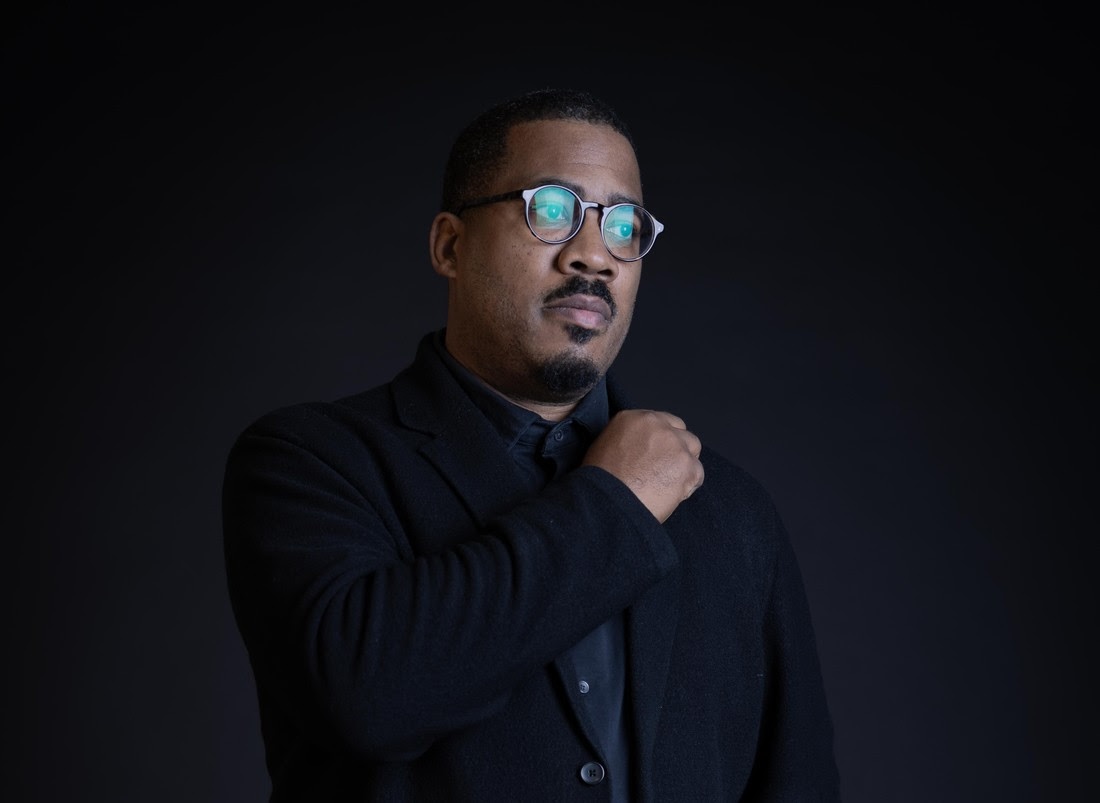
Contemporary jazz, the work of a 19th-century Czech composer, and a puppet show do not often intersect. Yet the music of Antonin Dvorak and a marionette theater troupe both play central roles in the new album from saxophonist James Brandon Lewis and his Red Lily band, Calling Antonin.
Rock listeners may be familiar with Lewis from his work with the Messthetics, a powerful jazz-rock group consisting of guitarist Anthony Pirog and the rhythm section of Fugazi, or possibly from his fusion-oriented albums on the Anti label. Those efforts form just one thread of Lewis’s prodigious output and dynamic practice. With the Red Lily group, Lewis likes to explore historical subjects, stretching the language of traditional acoustic jazz as in the process. The project’s debut, 2021’s Jesup Wagon, looked at the life of George Washington Carver, while 2023’s For Mahalia, With Love, delved into the gospel realm of singer Mahalia Jackson. Lewis became interested in Dvorak when asked by former Red Lily bassist William Parker to work with the Czechoslovak-American Marionette Theater Company on a project about the composer’s time in America. In the liner notes, Lewis says that, prior to the project, he had only a passing familiarity with Dvorak but became increasingly fascinated as his work progressed.

The tracks on Calling Antonin that explicitly quote Dvorak’s music make it easy to hear what caught Lewis’ attention. “Lento” and “Going Home” both feature strong melodies reminiscent of old Black spirituals; the theme of “Lento” doesn’t sound too far off from “Wade in the Water,” which Lewis and co. took for a walk on For Mahalia, With Love. “Going Home,” meanwhile, has a bluesy, ebullient strut bolstering call-and-response passages that evoke a choir cutting loose. A listen to the Dvorak pieces that inspired both songs, the second movement of the “American” string quartet and the “Largo” section of the “New World” symphony, respectively, reveals that Lewis and Red Lily didn’t need to carry out a drastic overhaul—the cadence and tone of spirituals were already there. While in America, Dvorak worked with a young Black composer and singer named H.T. Burleigh, who taught the composer African American hymns. So, in some ways, Lewis and Red Lily aren’t interpreting Dvorak so much as reclaiming the material he made use of, complicating its rhythms, extending its harmonies, giving it both old-time fire and modern sophistication.
Lewis has added violist Melanie Dyer to the group and drafted the formidable Tomeka Reid for the cello seat (replacing Chris Hoffman), enhancing the ensemble’s potential for symphonic textures and colors; Kirk Knuffke (cornet) and Lewis mainstay Chad Taylor (drums) return, while Joshua Abrams (Natural Information Society) takes over for William Parker on bass. The combination of new blood and old hands results in some electric interplay—check out how the drone of the strings, Taylor’s hi-hat pulse, a creeping bass line, and a fractured cornet solo turn the soulful “Dilemma of Hearts” into a spontaneous whirlwind before Lewis’ lyrical, buzzing line—playing the theme from the last movement of the “New World”—restores order. Or listen to Lewis’ teeming, offbeat, tightly phrased solo on the title track, which turns one of Dvorak’s Slavonic Dances into a driving hard-bop manifesto.
As a work of historical investigation, Calling Antonin succeeds through its seriousness—Lewis and Red Lily treat Dvorak’s themes, inspirations and motifs with curiosity and respect. But more importantly, Lewis and his band honor their unlikely source material while transforming it into something surprising, uncompromising and fiercely alive—from a new world and for a new world.