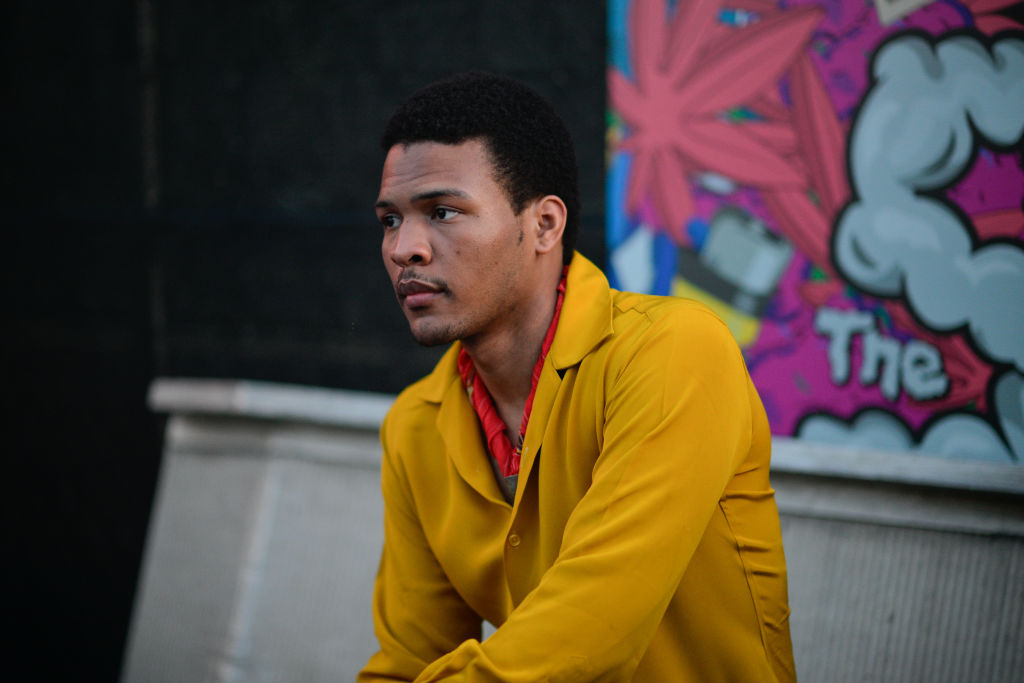
There’s something exciting about an artist you can’t quite pin down. And while he’s taking his time, releasing a few stand-out, smoldering singles, Buddy Red is one of the most promising young talents in music.
“I love New York, man,” Buddy tells me, sitting down for lunch. He confesses to also loving the NYC subway system, finding traffic in his native Atlanta “unfavorable” at times.
At only 25, he elucidates how Atlanta has changed in his lifetime, and how he’s changed along with it. He sensitively offers condolences when he discovers my dog passed away, and makes a note to investigate Burt Bacharach’s songbook (having not heard of Bacharach). He apologizes for cutting me off (he didn’t) when we’re discussing the messy potential of progress, or lack thereof, in world history.
“American history is a big example of that,” he says, his voice clear and thoughtful. “Without it, we probably wouldn’t have the blues.”
When I ask if he’d like to be addressed as Buddy or Messiah, his given name, he immediately says: “Buddy.” Messiah, he feels, has too much “behind it.”
I’d spent the night before cramming T.I. & Tiny: The Family Hustle, a reality show that launched on VH1 in 2011 and ran for six seasons, to get a glimpse into young Messiah, the oldest son of rapper T.I. and Lashon Thompson, only 11 at the start of the series (Tameka “Tiny” Harris is his stepmother). The clips I saw were of fun-filled vacations and revealed a big, blended family with even bigger personalities. Mention of the show makes Buddy wince affectionately, in the way, he says, when someone refers to “home clips when you were a baby.”
Deep ties don’t always create deep affection. It’s very clear, though, that Buddy has deep love for his family.
Growing up on television and the son of rap royalty, you might think you know Buddy Red already, and the fact that he looks like his father, he tells me, created even more expectation. “I tried to get away from that because even though I didn’t know who I was, I knew that I was somebody different from my father.” Once he started creating his own music, the comparisons were to Jimi Hendrix and Lenny Kravitz, and though he’s hoping he can be known for his own style and sound, it’s impossible not to point out that there are bigger problems than being aligned with two musical legends. Even the first few bars of his single, “Sold His Soul,” draw you in with a nostalgic ’60s psychedelica, packing a power punch with his rich Hendrix-esque vocals. The video exhibits undeniable swagger, a level of showmanship that’s innate and clearly something he can channel when needed.
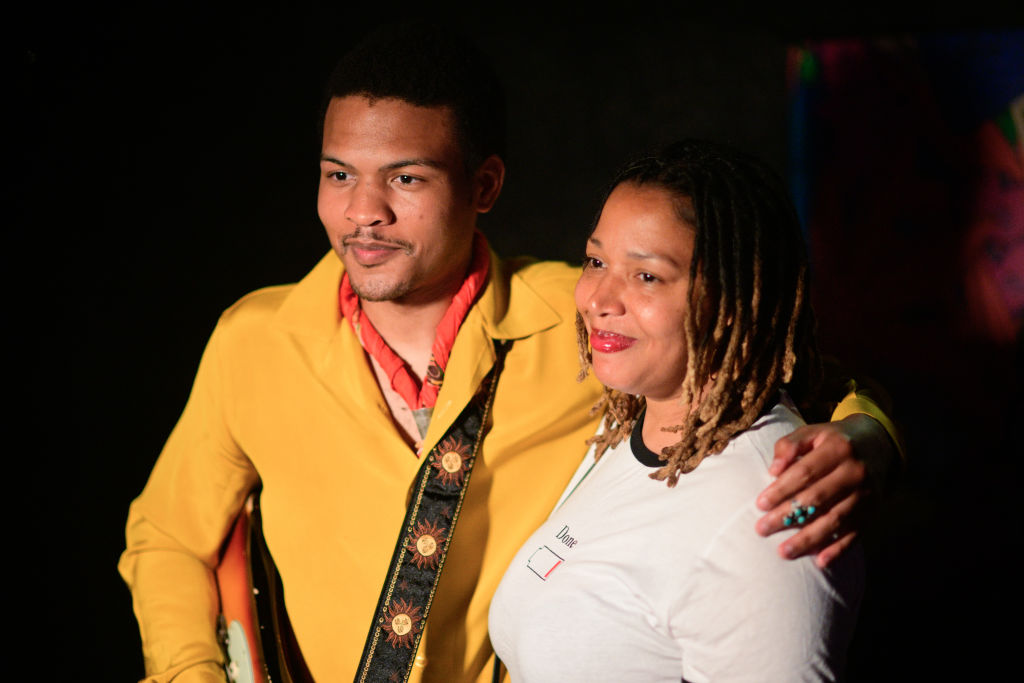
Buddy’s story naturally drifts back to family. His father was born Clifford Joseph Harris Jr. in 1980, and grew up in a very different Atlanta from the one Buddy knows. “My father, he would spend his school days in Atlanta, but on summer break he would travel up to New York to see his father. I know my family has some kind of tie to New York. I find myself asking, ‘Why do I like New York so much?’ Then I remember that my grandfather used to live here.” His grandfather went by Buddy.
“My aunt, who’s since passed away, she knew all about our family history. She told me, ‘You were the only one that your Grandpa Buddy got to hold before he passed.’ I feel special in that sense that I got to meet him.”
When he came up with the name Buddy Red, he drew on both family ties and the music that inspires him most: Muddy Waters, Pink Floyd, Jimi Hendrix, Led Zeppelin, Bob Dylan. “They have a first and a last name,” he explains. “Messiah Harris? Sounds like… maybe an actor… I don’t know.” Pink Floyd’s process of putting together two first names (from blues musicians Pink Anderson and Floyd Council) sparked Buddy Red. Buddy from his father’s side, and Red for his Uncle Red, his mother’s brother, the one who also loved Led Zeppelin.
His family can’t help but produce certifiable stars, starting with T.I. and including his one-year-younger brother, Domani. Domani, though very much his own artist, followed in his father’s hip-hop footsteps, and is a huge success. With Buddy’s unique bluesy rock, his path was in no way clearly laid out. But Buddy just kept playing, developing his sound, and listening to the musicians that motivated him — including Robert Johnson, an artist typically cast (or miscast, depending on who you ask) in the mythic tale of selling his soul to the devil at a Mississippi crossroads for his otherworldly music.
Buddy found himself at a crossroad of his own. “It was a fear of mine,” he says, of the possibility of selling his own soul, that fueled “Sold His Soul”. The song was inspired by a passionate exchange with Domani, and then penned on a bus to classes at Georgia State University. “It was one of those talks where he was telling me, ‘You need to worry about this. You need to think about that. If you want to make it, you got to do this.’ He’s telling me like he’s a father or he’s my older brother. I was so frustrated. I remember being on the shuttle bus, going to class after this irritating conversation. I’m just writing, really venting about what it would take for me to do what he wants me to do, what he thinks I should do. In my mind, I’m thinking, I would have to sell my soul, or I would have to just give up who I am and be somebody completely different if I want to make it.”
Buddy asked himself what that would look like: “It looks like me selling my soul for a dollar,” was his answer.
“I look at it as growth,” he says. “I look at it as if you want to get somewhere that you’ve never been, you’re going to have to let go of things that you aren’t anymore.”

Telling T.I. he’d decided to pursue music, and was going to blaze his own path, was a defining moment. “My pops, I think sometimes he worries about the world I’m stepping into, number one, because he doesn’t understand it as much as he understands the rap and R&B world. When he looks at what I’m doing, he thinks sex, money, drugs, rock and roll, sure. I don’t even know if he has something to worry about or not. I think he and I both know that I’m going to soar soon, and he just wants to do whatever he can to make sure I soar safely.
“As a person, and as a father, as a man, as a businessman, all things considered, he’s doing great. I can’t imagine any other person doing much better than he is right now,” Buddy says. “My siblings, we’re all, in a way, different versions of my father. When people look at me and they see what I can do, I look at my pops and I think about what he could have done if he didn’t have to do what he had to do to survive in his world in the ’80s, the ’90s in Atlanta. When I think about those things, I’m even more grateful for him because I’m an extension of him.
“People will tell me stories about him like, ‘Man, when we were growing up and we were in the studio, your daddy was making the beats. We couldn’t afford to produce them, so he was trying to figure it out.’ I think about how I used to make beats before I was playing the guitar. I’m thinking, ‘What if my pops kept making beats? Would he have eventually picked up an instrument, too?’ I saw a picture of my father holding the guitar and trying to play it. I was thinking, ‘I wonder if he’s doing that because he sees that I can do it, and he’s trying to picture himself doing it as well?’
“That’s a trip to me, and it’s beautiful.”