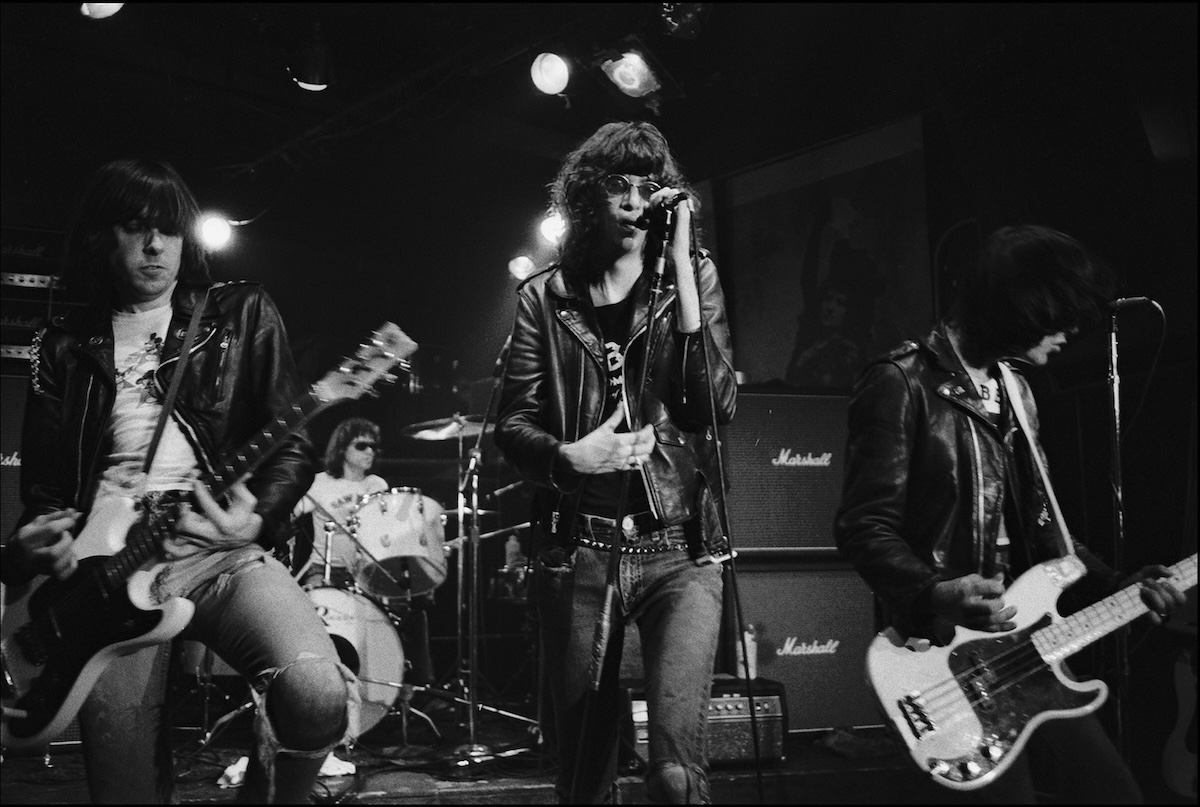
“They were the Unfab Four,” Craig Leon laughs. Co-producing the Ramones’ 1976 debut album was like stepping into a strange Bizarro World-meets-the-Beatles for the producer. Co-produced with the Ramones drummer Tommy Ramone (Tommy Erdelyi), the sessions were close to entering that alternate DC Comics universe that ran from the late 1950s through the late ’60s, where superheroes like Superman were depicted as twisted opposites of their form.
“It was Earth and all the characters from the comic books, but inverted,” says Leon. “Things that were good were bad. Characters would be repulsed by a flower and love a garbage heap, and that’s basically the premise that I wanted to see. I was also thinking in terms of something that could establish them.”
If the Ramones had made a “slick” album, says Leon, it would have sounded more like the Stooges or MC5 but with “weirder lyrics,” and that wouldn’t have worked. “I thought, ‘Let’s do something that reflected their personality,” he says, “and they liked the idea of being the negative Beatles. They were the Beatles of Bizarro World.”
Ramones was the antithesis of arena and prog rock, and anything else that was mainstream by the mid-1970s, stripped down to its bare bones, “loud and fast,” and sequenced by three-chord tracks all under three minutes. It was a minimalist doctrine of punk rock, and an amalgamation of all the rock that came before from the opening barrage of “Blitzkrieg Bop” and humorous brutality of “Beat on the Brat” or “Chain Saw” and the horror-themed “I Don’t Wanna Go Down to the Basement” to the more sentimental coax of “I Wanna Be Your Boyfriend,” the rougher edges of the Dee Dee Ramone (Doug Colvin) darker chronicle of male prostitution and addiction, “53rd and 3rd,” and the AM radio oldies-inspired “Let’s Dance.”

The simplicity of Ramones provided an early blueprint for bands like U2, Metallica, Green Day, Blink-182, and a legion more to do as they wished. Metallica has often called the Ramones an early influence, specifically the guitar playing of Johnny Ramone (John Cummings), which helped shape James Hetfield’s own style, while Pearl Jam leaned toward the band’s raw, aggressive sound and quick-fix tracks.
And true to the Ramones’ form, the album came together in the most makeshift fashion—rigged equipment, pulling in studio standers-by on backing vocals and harmonies, and other sound effects, and glueing everything together, piecemeal, with a week and a low budget.
At the time, Mickey Leigh, the younger brother of Joey Ramone (Jeff Hyman) was studying music theory and composition at Queensborough Community College, and became the band’s jack-of-all-trades, from hauling equipment and transporting the band to shows in his car to managing sound checks and other road manager duties to playing and singing in the studio, where needed.
Years before Ramones, Leigh was there during the origin of some of the band’s songs, playing guitar with brother Joey in their bedroom in Forest Hills, Queens, to the band’s earliest rehearsals in the basement of their mother’s art gallery.
“I gave my brother my guitar,” says Leigh. “He was playing on it and didn’t want me to know, but I saw the scratches and stuff, and I said, ‘Listen, I know you’re playing my guitar.’” Leigh started teaching his brother, who was left-handed. Instead of switching the strings each time, he turned his Yamaha acoustic guitar into a two-stringer for Joey and learned his first song, Alice Cooper’s “I’m Eighteen.”
“He was playing that like 20 times a day,” remembers Leigh. “From those chords he wrote, ‘I Don’t Care,’ and ‘Here Today, Gone Tomorrow.’”

When the band was signed in late 1975, Leigh was eventually given a salary of $50 per week and continued on as their “utility player,” assisting during the Ramones sessions, playing guitar, tinkering on the drums, and providing backing vocals, where needed. Leigh was even there to help the band copyright their songs, since he had learned how to write music notation and transcribed the band’s songs from reel-to-reel tapes.
Though there were some early disagreements on the sound during the early Ramones sessions—Tommy wanted overdubs, and Johnny disagreed—one sound they could all agree on, says Leigh, was the Who’s 1970 Live at Leeds album, which helped guide Ramones.
“We all loved the Who’s Live at Leeds album, and there were no overdubs on that, but it sounded big, and it sounded great,” says Leigh. “And Tommy said, ‘Yeah, but that’s a live album. People are used to hearing live albums that way.’ Then Johnny said, ‘Exactly, and we all love it. It sounds great. Why can’t we do it that way?”
Another Who song, “Heaven and Hell,” a B-side to “Summertime Blues” in 1970, was also instrumental in helping the band find some compromise.
“I guess it helped everybody come to an understanding,” says Leigh. “It was sort of a compromise. It [Ramones] wound up being almost recorded as a live album. It was decided that that’s how they were going to do that album. There would be no overdubs or things like that.”
From there, Leigh says Leon was also forced to rethink the way he made records. Classically trained, Leon, who went on to produce Blondie, Suicide, Berlin, and the Bangles, was first swayed by rock and roll, soul, and R&B as a kid during the 1960s, along with early garage punk bands like the Bobby Fuller Four. It worked as the perfect segue into what was unfolding with the punk scene in New York City.
At the time, Leon was working out of his small studio in Florida when his friend and mentor Richard Gottehrer, who co-owned Sire Records with his cousin Seymour Stein, suggested he work with the Ramones after he had done some work with the British group Climax Blue Band.

Leon first saw the Ramones play at CBGB in early 1975 and was immediately drawn to the band, despite their messiness. “I thought this was incredibly raw, but it’s incredibly good in the aspect that they were like the anti-version of everything that was getting overblown.”
Leon craved something different than what was all over the airwaves. “I wasn’t anti-folk or against bands like the Eagles,” says Leon. “I was against the way that they made records.”
The Ramones were like “performance art” to Leon, who was later instrumental in helping the band get signed to Sire. “It was like one big piece of 15 little segments or 10 segments. They would play, then argue with each other and go, ‘You came in wrong. What song do you want to do? I don’t want to do that one.’ They would play for 20 or 30 seconds, and it would fall apart, and then they’d do another song, and another.”
If that energy could be put into song, thought Leon, he was sure the band deserved a label and an album. “I wanted to help them get out there,” he says.
By January 1976, shortly after the Ramones were signed, Leon was on board to produce their debut, equipped with a budget of $6,400 and seven days at Plaza Sound Studios in New York City, a space originally built for the NBC Symphony Orchestra, and formerly located on the eighth floor of Radio City Music Hall.
The band already had a group of demos they had recorded at 914 Sound Studios in Blauvelt, New York, one of the studios where Tommy worked. The fact that the band was putting out an album, says Leon, especially something so underground during the ’70s, was a feat in itself.
Initially, Sire offered the band a singles deal, which Leon encouraged them to turn down and proposed making an album for the budget of two singles. The label obliged but gave them a smaller budget, which was a stretch in the analog days.
“I wanted to do something radically different,” says Leon. “Tommy wanted to do something pretty much down the middle, and everybody in the band had their own ideas, but it all kind of came together.”

With Joey into more “British AM radio pop” and Johnny into harder rock like the Stooges, it all came back to the Who’s Live at Leeds.
“That’s part of the idea where we went for the split stereo, like in England, when they had three-track recorders and had bass on one side, guitar, and then drums down the middle,” says Leon. “The Beatles had that in the beginning by necessity. I wanted it because I wanted to turn everything topsy turvy, like the Ramones did.”
He adds, “We wanted it to be a really raw version of that 1960s recording technique, and getting them to be raw wasn’t that hard.”
In the studio, the band measured time by a flashing light metronome Tommy set up, and instruments were isolated by adjoining rooms, with guitars spilling into the Rockettes’ dressing rooms.
“We had the bass and all the amplifiers set up in one room, the guitar in another, the drums in a room that was much bigger than a drum booth,” remembers Leon. “And then there was the Rockettes rehearsal hall, which was a big glass mirrored space where they could see themselves [practicing], and John’s amps were all in there. And they [the band] stood in the hallway, in the middle of the three rooms with the control room off to the side.”
To polish up the sound, Leon did work in some overdubs to add texture to the guitars and fill in the vocals, which were added by the band, along with himself, Leigh, and engineer Rob Freeman—who can be heard singing the final refrain on “I Wanna Be Your Boyfriend.” The band’s then-manager, Danny Fields, and artistic director Arturo Vega—responsible for creating the iconic Ramones logo—also added hand claps on the album.
“It was real homemade stuff, because we couldn’t pay anybody,” says Leon. “It goes back to this whole thing of the Ramones music being part of the music of that era of urban New York, because everybody on it was true to who they were. And it was something that everybody wanted to do.”
Everything was pulled from somewhere. Even the start of the Ramones opener “Blitzkrieg Bop,” says Leon, was “nicked” from the Bay City Rollers. At one point, a young vocalist was recommended to come in and sing background vocals on the album, but the label wouldn’t cover his train ticket from Connecticut to New York City, which resulted in more DIY vocals.

“He [Seymour Stein] said, ‘We don’t have the budget to do that. Do it with what you got,’” remembers Leon. “So that guy didn’t do it. And that guy’s name was Michael Bolotin, and he later changed it to Bolton. So Michael Bolton was almost on the Ramones album.”
During the 30th anniversary of the album, engineer Freeman vividly remembered recording Ramones: “Ramones collided with a piece of two-inch magnetic tape like a downhill semi with no brakes slamming into a brick wall.”
Along with assistant engineer Don Hünerberg, Freeman was one of the few people, outside of the band, in the rooms during the Ramones sessions, but he never imagined the album becoming so iconic when he thinks back to everyone planted inside Plaza Studios 50 years ago.
“When I listen to the Ramones album now, I hear a solid, cohesive, and powerful statement made all the more fascinating by just how black and white sounding it is,” says Freeman. “I hear Plaza Sound, the studio’s mighty acoustics making their indelible imprint all over the record. I never could have predicted that 50 years after making that album, of all the records I made in a long career, Ramones would be the one everybody wants to talk about.”
To this day, Freeman says artists from all over the world still reach out to him, trying to reproduce that Ramones sound, asking which microphones and mic placements, recording consoles, and outboard equipment were used during the sessions. “It’s incredible how this little project, which took all of six days [seven, total] to complete, has had the tremendous impact that it has,” says Freeman. “I had no idea the Ramones album would go on to become as iconic as it is.”
For Leigh, however many decades pass, the Ramones are still alive, in the band’s music, and history, which he tries to keep present, along with his brother’s memory and the annual Joey Ramone Birthday Bash! on May 19.
“You wonder if it was real or not,” says Leigh. “It just reminds me that my brother’s not here, when I hear his voice, or when I hear somebody talk about the Ramones. It brings me back to the fact that it was reality.”
Before his brother’s death in 2001 after a lengthy battle with lymphoma, Leigh, who as Sibling Rivalry released an EP with Joey in 1994 called In A Family Way, says they would have explored more music together, but their next collaboration, joined by their father and uncle, was opening a new music venue in New York City, to house Joey’s “Unsigned” events, showcasing unsigned bands, among other ventures, and to help promote local bands.
Thinking back on 50 years since Ramones was released, Leigh says it still doesn’t seem real. It’s almost like a dream.
“It’s like you wake up and you’re having a dream, and it feels so real,” says Leigh. “That’s how it feels. I feel like I woke up in the middle of a dream, and it takes a few hours to accept that it was a dream. Except, it wasn’t a dream.”