
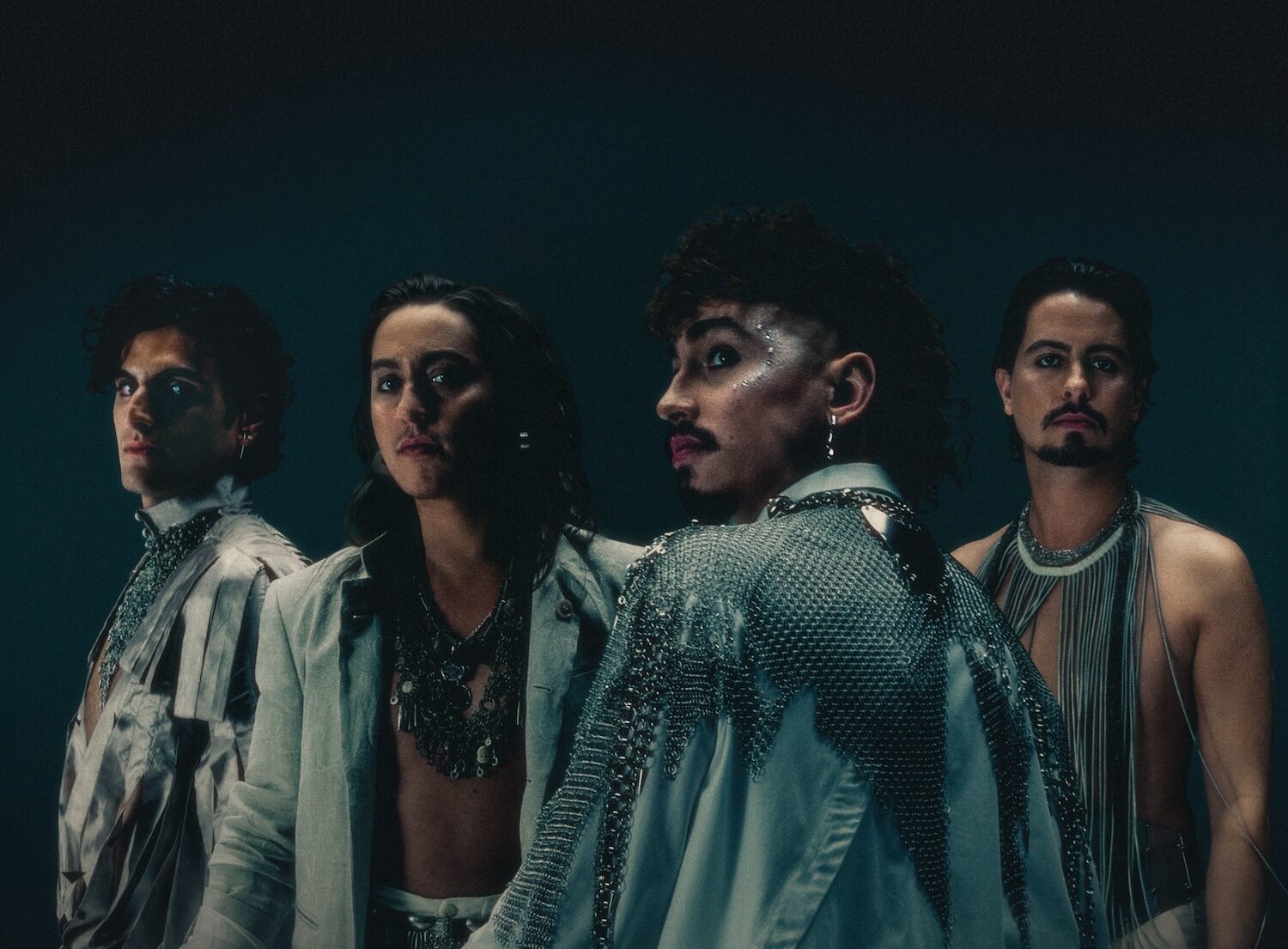
The one thought that’s top of mind when getting ready to interview Greta Van Fleet is: What to wear? When the band walks into the Los Angeles hotel they’re headquartered in while in town to promote their latest album, Palace for the People, I know I was right to think fashion would be crucial to our encounter.
“I love what you’re wearing,” is the first thing vocalist Josh Kiszka says to me. We’re both wearing denim, albeit very different versions. Mine is a simple summer dress; his is a pearl-studded, collarless jacket that he says he “stole” from a styling session. He’s pretty blinged out, with brooches pinned to his Dodgers cap and multiple earrings: cuffs, dangling, a row of, dare I say, diamonds. He is quite blinding. I expected nothing less.
A few minutes later, his twin brother Jake, the group’s guitarist, seeks me out and says, “I meant to tell you, I really like what you’re wearing.” I can’t stop smiling as I confess I put a lot of thought into my presentation for them. He wears dark glasses, a multi-medallion chain, bracelets, and a watch. The accessories, combined with his amazing long locks, give his grey-green blazer a rock star flair.
They all have that intangible extra-ness of rock band members. The twins’ younger, multi-instrumentalist brother Sam is also wearing a blazer, a brown one as part of a suit. The black-and-white patterned shirt underneath has many open buttons. This is standard. I’ve seen this band’s collective nipples more often than I’ve seen my own. He has flipped the look from stylishly casual to resort rock star. Their drummer, Daniel Wagner, is the most understated of the four, yet looks effortlessly sharp, with flawless skin and perfect teeth, a scarf tidily tied around his neck signaling that he’s not your average nice-looking fellow.
As we walk down the hallway to their suite, Jake tells me he saw Anthrax and Cheap Trick at the hotel that week, observing that the place is a “musician hotel.” When we arrive at the room, a couple of minutes in, Josh asks why it’s dark, and we point out that he’s still wearing his shades. He whips them off, laughing. These guys are confident, friendly, and exciting to be around.
I am a massive fan of their Grammy-winning music and an outspoken advocate for their live performances. So much so that I was a little concerned that the real-life version of them might be a letdown. Far from it. They never interrupt each other, which can be difficult to avoid when you’re being interviewed as a group and all of you have something to say. Even Daniel, who is quiet but a keen listener, interjects when necessary. And when I say something they agree with, they point at me, making me feel especially validated.
Observing an empty clothing rack against the wall, I ask what had been on it. Josh says they were trying on “Lots of shit,” mainly for photo shoots, and that they came away with 10 looks each. They are fine with all the clothes talk. “We love fashion,” he says. “I love dressing up. It’s fun.”
Following them for the last 10 years or so, I admit that part of my excitement is not just for new music from them, but also for the new worlds they create with their aesthetic. I’m not alone. Earlier this year, they performed underplays at the Bowery Ballroom in NYC and Chicago’s Metro, and from what Sam says, the fans were looking out for what the band would be wearing.

“Daniel and I jumped in selling tickets,” he recounts. “We were wearing black suits, like usher types. And [the attendees] were like, ‘What are you going to be wearing? Is it black? What color is it?’ I didn’t realize how much the fans really cared about what we’re wearing on stage. I realized it in that moment.”
“Fashion’s such a huge part of our expression, as it is for most artists,” says Jake. “We go loud and big sometimes. It’s a form of communication and self-expression. It gives people permission to open up. There was one show I remember where everybody showed up dressed like us. Ever since that happened, that’s just been the way it’s been.”
Aspirational as Greta Van Fleet are style-wise, there’s something inherently unattainable about their presence, an out-of-the-ordinary quality, a degree of excess that a “regular” person would have a difficult time pulling off. And it’s all intentional.
“Definitely,” says Josh when asked if they think about what they’re going to wear with each album. “The production too, what it might look like, is part of the world we are inhabiting sonically. We all have our own characteristics, and it stays true to the foundation of our individual personalities.”
“We wrote a record called Palace for the People, and every evening we take over this arena, or whatever, and that becomes the palace,” says Jake. “What does the inside of that look like? What does the production look like? What are we wearing? It’s like Josh was saying, we’re completely inhabiting that world. It’s being built right now, as we speak. It’ll be interesting to play in that, break rules and invent new ones.”
Back when Sam contributed to the inaugural installment of my “The Essentials” column at SPIN, timed to their 2023 album Starcatcher, I described their albums as “volumes in a fantasy book series, each one reveals another layer of a mystical universe…” I noted the slight stylistic shifts from “anthemic blues rock to cinematic prog rock to psychedelic space rock.” On Palace for the People, they’ve expanded their palette to include a myriad of influences, so much so that the album almost plays like a thoughtfully curated and cohesive compilation.
“I don’t think we repeat it ourselves, and that’s the highest achievement,” says Jake. “It’s a huge prerogative. It’s a mission statement of Greta Van Fleet to never repeat ourselves. There’s enough music and there’s enough beauty in the world that we don’t have to. That’s the crowning glory of achievement for any person who writes songs and makes music is to create something feeling that people feel like they’ve heard it before and they can identify with it because they’re familiar with it, but it’s also fresh and new and in a territory of its own.”

The one persistent, if tired, criticism of the group, it’s their similarity to Led Zeppelin, primarily due to Josh’s distinct voice. I don’t bring it up, but they do. “Do journalists even talk shit anymore?” Sam asks, not referring to his band, but to criticism in general. When I respond with a flat, “No,” he says, “I miss that.”
“We got a lot of fucking entertainment out of that stuff,” Jake says of the scathing press they received. “It was very, very funny.”
“They were fucking castrating us,” Josh reminds them. “They’re like, ‘How are these kids coming in here? They’re hell on rock ‘n roll.’ I’m pretty sure we’re trying to move things along in a very beautiful way. It’s coming from a place of genuine love and respect and appreciation.”
On his podcast and YouTube series, Justin Hawkins Rides Again, the Darkness frontperson has dissected Greta Van Fleet more than once, offering both positive and negative commentary. But one thing he says stands out to me: “Is sounding like Led Zeppelin really a criticism? Led Zeppelin are one of the greatest bands that ever graced the Earth.” The other thing he says is: “As soon as he [Josh] starts singing, it’s just fucking awesome. He’s got a great voice—a great voice.” Elsewhere he says, “You can’t listen to that guy sing without being excited—unless you’re a little bit dead inside.”
I share Hawkins’ observations with the Greta guys, and Josh needs to be reminded who Hawkins is. They jog his memory and he instantly starts singing the Darkness’ biggest hit, “I Believe in a Thing Called Love.” As Hawkins says, it is fucking awesome, and it’s happening right next to me.
In 2018, when they were teenagers, I experienced Greta Van Fleet up close at the Hollywood Masonic, and again a few years later at the Greek Theatre. That second time was during a fortnight of back-to-back concerts at the tail-end of the pandemic in 2021. They were superior to anything else and ruined us for the shows we saw after them.
That was probably the last time the band performed in anything smaller than an arena, until the underplays earlier this year brought them in close contact with their audience. “We love those rooms,” says Sam. “We love playing arenas, but we love getting a little bit more close to the people.”
“It’s great to get back in a room because you can see the walls,” says Josh. “It’s not just this infinite field of stars, going, ‘Where do I start and where does that end?’ It was really incredible to connect with people intimately in those settings.”

“That’s part of the whole crazy trajectory we’ve been thrust into in some ways,” adds Jake. “Another thing to be said about playing these clubs is to wake the dragon back up. We felt like we were a rock ‘n roll band again in a way, because there’s the theatricality of these big shows and we’re performing, but we’re not just musicians at that point. We’re entertainers. In the club setting, that sense of intimacy felt like it was you and the people.”
“Since day one, we’ve been a live band,” says Daniel. “In the early days, we would play five-hour shows, not because we had to, but because we wanted to. The live performance is where the true identity of our nature lives. We were kids in the garage playing rock ‘n roll music again. It was refreshing.”
It’s not just Greta Van Fleet connecting with their fans at the shows, but fans connecting with each other. No matter the size of the venue, the multi-generational audiences surrounding me at Greta Van Fleet concerts want to interact. They want to know if I’ve seen them before. They want to tell me how and when they got their tickets. They want to discuss their favorite songs and give me their ranking of the albums. It’s an unexpected but pleasant change from crowds who pretend they can’t see anyone around them.
“That’s the coolest fucking thing,” Sam says. “Obviously we don’t have the greatest perspective on being in the audience at our show, but I’ve been to a lot of shows, and you’re right, people don’t talk. That is great to hear that people [at our shows] are so interactive.”
“I think the commonality between all of them is music,” says Jake. “They’re excited to talk to each other because—I’m assuming—they want to share their stories and their love for something.”
“I always thought that connection is maybe somehow informative,” says Josh. “That what we’re creating as artists, as musicians, perhaps might have some connective tissue that crosses generations. It’s coming from that good place where all that information that everybody’s registering in the room, we can get down to that. It’s like a religious experience. The music is bigger than everyone in the room, and we’re all experiencing it together. And it never happens twice. We could play the same set if we wanted to—although we change it up—and it would be very different every single show.”
Even if they weren’t aware of the sense of unity in their audience, that theme is a central one of Palace for the People. The titular palace is Alexandra Palace in North London, where they performed in 2022. Coincidentally, it’s in the neighborhood where my best friend lived for decades, and the address we would give minicab drivers when going home after late-night clubbing. It’s a beautiful location, with its park providing a scenic view of London from its hilltop vantage point.

They learned the history of what the locals affectionately call “Ally Pally” when they performed there. It was built in the 1800s as a space for entertainment, recreation, and education for the public, hence its original name, “Palace of the People” or “People’s Palace.” The concept captured their imagination and came to the fore when conversations about the album began. The term “Palace of the People” already sounded like a Greta Van Fleet album title to Josh, who says it triggered a “sense of equality inside of humanity” for him.
“The whole idea was to siphon and create music through that analogy and that philosophy,” says Jake. “So many times there’s fixation on the hero with 1,000 faces or the idea that we become godlike. But this is telling an opposite story. It’s not about gods or kings or rulers or majesty or monarchy. It’s about people, the essence of humanity and unity we all share.”
“Any space where we’re performing is inclusive so everybody walking through the door is welcome,” says Josh. “If someone felt unsafe at one of our shows, I’d be embarrassed. It’s your responsibility to provide a safe space for everybody. We’re on the same wavelength. It’s proof that people love people and people need people. It’s very cool.”
The album was produced by multi-genre talent Mike Elizondo at his isolated studio near Nashville, a half-hour drive for the band members, who live scattered around the area. Elizondo’s wide-ranging production discography, which swings from hip-hop to country, rock and R&B, attracted Greta Van Fleet. They discussed their concepts with him and established the ideology of the music before entering the studio. Additionally, the group wanted to experiment with cultural and world influences, specifically Qawwali, Sufi, Indian, and ancient Eastern European folk music. Elizondo’s extensive experience helped them get where they wanted to go.
There are strings, including a Marxophone, and brass instruments that extend beyond the usual, including a cimbasso, as well as the traditional Indian woodwind instrument shehnai. The album features unconventional melodies and world music-influenced percussion that bring a new level of interest to Greta Van Fleet’s classic sounds.
“It’s all rock ‘n roll to us,” says Sam.
“That’s the beautiful thing about rock ‘n roll, it wears every hat it wants to,” Jake adds. “It’s more of a philosophy, isn’t it?”
What’s remained consistent is the live sound that’s been a signature of all Greta Van Fleet releases, which comes from them playing in the room together. “That’s one thing that will forever remain a pattern with us,” says Daniel. “When we’re recording, we have to be in the same room together. I don’t think any of us could ever finish an album any other way. That’s how we started playing music in the first place, and that’s all we really know. That’s how you actually communicate with one another when you’re working. Mike understood that, and very often he was in the room with us in the early stages of the projects.”
“For better or for worse, there’s grit and then there’s grace,” says Jake. “There’s beauty and there’s barbarity. The polarities of these things make a good record. A record has to be a little sloppy, a little fucked up, if you will. That’s how you get that ‘live.’ That’s the human thing. By no means are any of the records we’ve ever released—by technical standards—perfect records. They’re actually kind of imperfect, but that’s what makes it beautiful, and that’s what makes it human.”
I don’t like “sloppy” as an adjective for this band so Jake offers “unhinged” instead, “it pushes and pulls. It’s not right on.” It’s that unhinged element that connects with listeners who inherently respond to it as a shared commonality. This is also reflected in the themes of the album. As mentioned earlier, unity is a central one.
“Unity is the driving theme,” says Jake. “It’s reminding us that we’re all humans and we’re all created equal. We all love. We all feel these emotions. That’s what it is to be human and the human experience. We’re not worlds apart.”
Says Sam, “We should try to understand and communicate with each other more—which is why I’m so happy that you told us that people are open communicators at the Greta Van Fleet shows because you can exchange ideas. A lot of people are glued to their social media or the internet whereas real human interaction is abysmal. In a time where people’s ideologies keep shifting more and more into ‘us’ and ‘them’ over really stupid, unimportant things, everybody come here and let’s celebrate life.”
The band’s Into The Beginning Tour kicks off Wednesday, February 3 in Savannah, GA at Enmarket Arena. General on sale begins Friday, October 9 at 10:00 AM local for European Dates and Thursday, October 15 local for North American Dates. Pre-sales available through GretaVanFleet.com.