It takes a true superfan to understand and deliver what other fans want—and what they’re willing to pay for. Dan Berkowitz has built a business around enhanced music experiences, bringing together all the elements that make live music moments special and taking them to the next level, from travel to meet-and-greets to thematic activations.
The Philadelphia native got his start helping his favorite group, the Disco Biscuits, with transportation in the early 2000s, organizing buses and shuttles to their shows. Under the name CID—short for “Consider It Dan”— his entertainment company grew quickly from there, cornering the jam band market and adding STS9, Umphrey’s McGee, and Gov’t Mule to his roster.
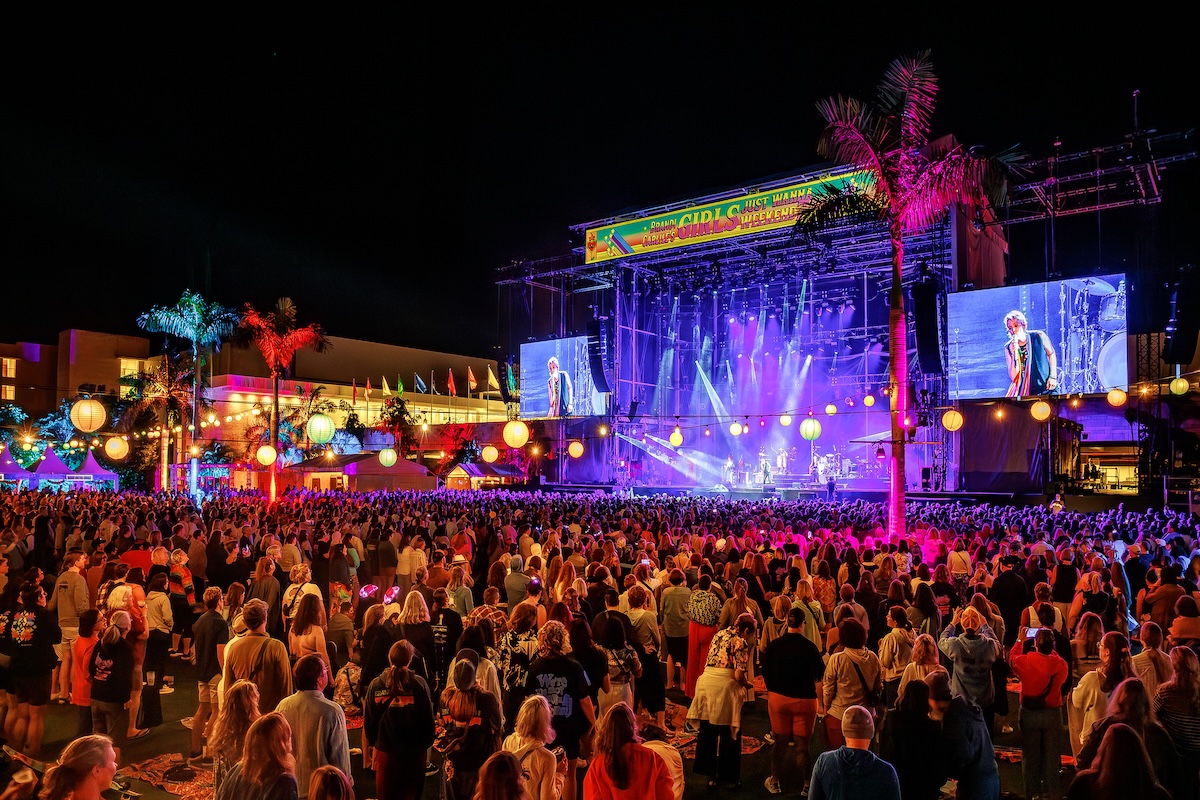
Specializing in packaged trips, premium seating, and unique gatherings, he went on to work with Metallica, Phish, George Strait, Kenny Chesney, Dead & Company, Chris Stapleton, Dave Matthews, Luke Bryan, and many more, brainstorming extras for their fans. Partnerships with Coachella, Bonnaroo, Austin City Limits, Lollapalooza, and more followed. Then he launched CID Presents, creating his own destination events, such as Luke Bryan’s Crash My Playa in 2015 and Phish: Riviera Maya in 2016.
The model was simple: offer fans a special, immersive experience that reflects not only the music artist but the fan community itself. This attention to the aspirational elements of fandom made everything Berkowitz created sell out and CID a big success. He sold the company to PrimeSport in 2016, and a bit later, launched his current company, 100x Hospitality. His artist partnerships, VIP hospitality, and destination packaged events have been setting new standards in the industry ever since.
SPIN spoke with the executive about his inspirations and approach to hospitality, and why fans continue to spend their hard-earned money—even in tough financial times—to be part of what he and their favorite artists create for them.

How did you get your start in events?
First and foremost, I was a huge live music fan. That’s what I loved to do. Some of my most poignant memories that stick out from my childhood and you know, teenage years and college years, were seeing live music. I specifically remember the very moment when I was at the Wetlands Preserve in 2001 with some of my favorite people in the world, seeing my favorite band at the time, the Disco Biscuits. It was on September 1, 2001. I remember thinking that I was in the exact right place at the exact right time with the exact right people, and to me, that was one of the best feelings on earth. So I knew that I wanted to do something that helped people get there. I thought about what I could do next, and I realized that doing these experiential packages for the fans… there was something there. Nobody was really doing anything like that. So it was literally school buses to and from the show at first, and then we would drop them off. And then I realized that they were all staying at the hotel so we would package the hotel room with tickets and a shuttle pass.
How did you expand the idea from there?
I got a job with Electric Factory concerts and they let me try it out there as well while I helped out with other production assistant type things. We did these amazing experiences with the Beastie Boys and MIA and the Roots, like Weekend in Philly trips. Then, in the most supportive way [they] said, “You got to go do this on your own.”
This was a new component of the concert experience at the time, right?
There was no VIP Nation. There was nothing… So Shelly Lazar, God rest her soul. Her nickname was ‘the MFTQ”— the Ticket Queen. She was the everything when it comes to VIP ticketing and things like that, so she was doing it, and she was doing it first. The Rolling Stones, Paul McCartney, Shelly Lazar… She was doing it, but not really as public. Not for any other reason other than there wasn’t an elegant way of making it public. Shelley had a list; she sold to her list. It was basically friends and family ticketing with a little bit of experiential on top. I learned that later. So to me, nothing like this was happening. But she was always so kind to me.
What was the big turning point that helped boost your work in this world?
I literally remember the day I was at the Death Cab for Cutie show at the Mann music center, I remember looking at my phone, seeing that Jonathan Levine was calling me and running out to the lawn so I could take the call. And he’s like, “I just got off the phone with Jill Lesh, and convinced her that we should do VIP ticketing for the upcoming Phil Lesh run at the Nokia Theatre in New York. We’re calling it the Phil-a-thon. We’re gonna do 14 nights at the Nokia Theatre. Can you get us a proposal by the end of the day tomorrow?” And I was like, “Oh my God, yes, of course I can.” I’d never thought about what was next. I’d never thought about growing. There was no startup culture or hustle. I was just surviving. I was just doing what I wanted to do with the bands I wanted to do it with, and helping connect people with the music that they love. And I was content. But that call is when things changed.
What are the components of a perfect VIP experience?
People come to our shows to see and hear live music, so the absolute core element of an “enhanced experience” is a great place to watch the show. That doesn’t mean the front row. It means a great spot that’s easy to get to, with great sight lines and great sound. On top of that, there are elements of hospitality that must be delivered at the highest level, if promised.
People want access to their favorite artists. That doesn’t necessarily mean one-on-one time with them; it means access to anything that helps create an authentic connection. We now have an exhibit on the road with Chris Stapleton that we’re all so proud of. His fans get there early, they spend a lot of time with what’s inside. We have an incredible relationship with the Stapleton camp, and they care deeply about their fans. That combination leads to a really impeccable experience. To that point: the core element of a meaningful VIP or enhanced experience is an artist who cares about their fans.

What feedback have you received from artists about how these experiences create a more personal connection to fans?
I really don’t want to put words in anyone’s mouth, but the proof is in how much we’ve done, and continue to do, with the artists we work with. The honor of my life and my career was working with the Grateful Dead organization. Bobby (Weir) was the most special person and artist. He cared SO deeply about his fans and the community that surrounded him and his many musical incarnations. We did so many amazing things together. We had him in three different bands down in Mexico, playing for as many as 6,000 people on the beach. We had him play in our VIP tent at Lockn’ for 250 people with Phil Lesh and Joe Russo. And we worked with him on so many of his tours, whether with Dead & Company or Wolf Bros. He kept giving more. He never stopped wanting to give the fans more. We lost Bobby in January, but I don’t believe he’s gone. He was so much more than his physical body, and he’s still here, in the music and in everyone who has ever felt it.
What advice would you give to people wanting to do what you do?
Start by caring deeply about connecting people with the music they love, and each other. What gives us 100 times an edge is that we care deeply about that. The way to succeed at what we do, which is a different offering than our competitors, is to care as much as we do. Once you care, go work harder than anyone else. Chase perfection, but don’t let it get in the way of very good. Accept that not everything will go perfectly. Be transparent with your partners. Be communicative with your guests. Take care of yourself! Take care of your team the way you’d want someone to take care of you, or the way you’d want your own children’s boss to take care of them.

Find someone you look up to and respect, and see if you can get into their orbit and provide value. Do NOT just ask to “pick their brain.” I was so fortunate that people like Coran Capshaw, Louis Messina, Shelly Lazar, Bernie Cahill, Kristina “Red” Tanner, Jonathan Levine, Paul Tollett, Skip Paige, Bill Fold, Jonathan Mayers, and Charlie Walker were willing to listen to a scrappy kid, share some of their knowledge, and show me a bit of how they did what they did.
Not everyone can afford these kinds of experiences. How do you reconcile that fact?
So the first thing that we’re going to do with everything, every single program, is we’re going to think about the show as a whole. Let’s just say there are 10,000 people coming to a show, and 300 of them are going to do VIP. There are 9,700 people whose experience matters just as much as our 300. I hate the word VIP—but it just is what it’s called. It doesn’t mean “very important person” to me. It just means an enhanced experience at the show. The concert experience is a direct in-person relationship with somebody and music and a musician that they love, and the emotional connection that people have with that music. I only want to enhance that for everybody.
What do you think is the future of this business sector?
I think as artists who haven’t even recorded a song yet eventually become stadium acts, enhanced experiences and travel packages will evolve far beyond where they are now. The artists of tomorrow are going to shows today that have a decent chance of offering something experiential, more than just a ticket, so naturally these offerings will become even more commonplace.
The ticket used to be the only transaction between a fan and the show they were going to see. Now we’re getting smarter, with pre-show and post-show activities that keep fans with like-minded people, transportation to and from the show, and a hotel filled with people who share a common interest. It’s hard to say exactly where this is going, but it will lead to deeper, even more meaningful experiences that create authentic connections between people and the music they love, and each other. I hope to be around to be part of that evolution.
More info on Berkowitz’s VIP experiences and packages at 100xhospitality.com.