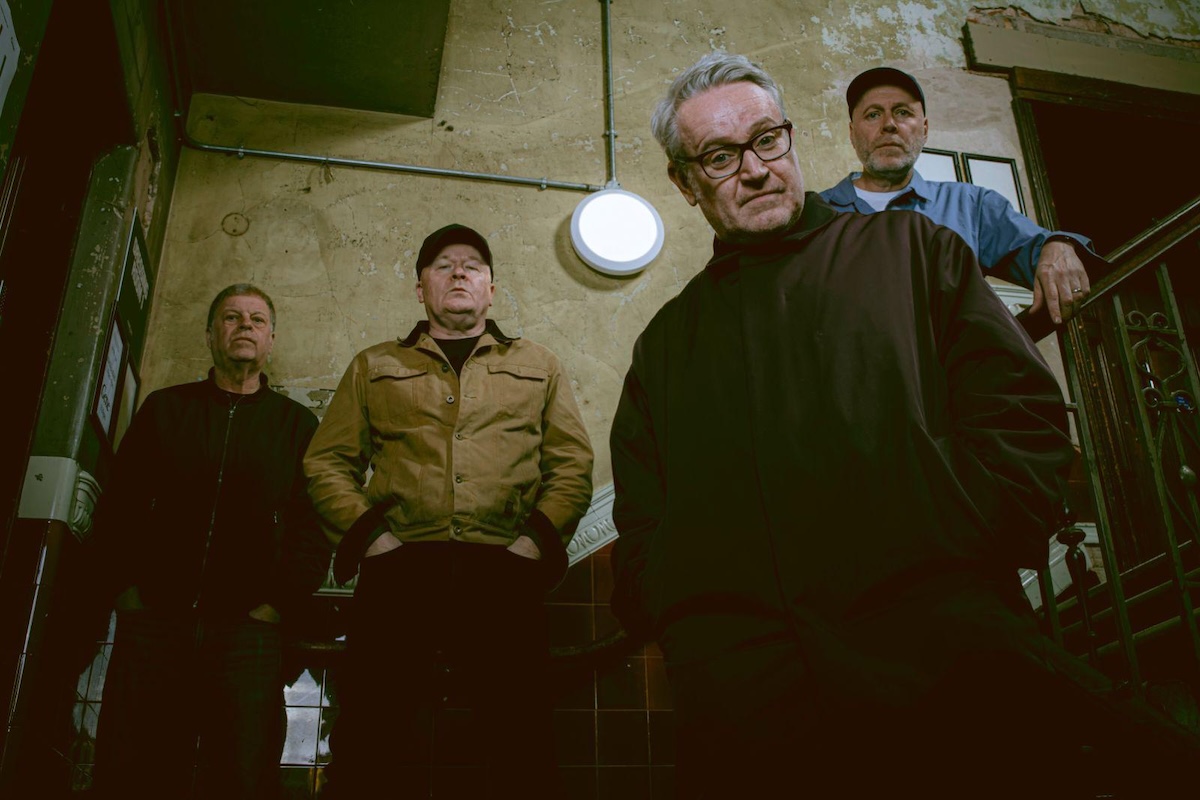
The last time I saw Martin Rossiter of Gene was in 2001, when he appeared on my internet radio show, which you could only hear if you had broadband. Almost nobody did, which is a shame, as he and his bandmates were in top form. Long after the Britpop bubble burst, Gene persevered, buoyed by a fan base that refused to let them disappear like so many of their peers. They eventually did disappear for nearly 24 years, reuniting in 2025 for a sold-out, 5,000-capacity show at London’s Hammersmith Apollo. The performance was released last May as the 20-song Apollo (Live).
The group arrives in North America this week for a run of dates in key markets, including a stop at Southern California’s Darker Waves Festival. When Martin appears on my screen, he’s wearing a Nike zip-up hoodie and puffing on a USB vape. I’m accustomed to seeing him in a suit jacket and never imagined he owned casual clothes. But we’ve both matured, and I adjust my expectations accordingly. Martin seems more grounded than I remember, but his humor remains just as sly and wry, if not more so.
In between Gene incarnations, Martin has taught music, specifically songwriting, to college students. He’s also raised three daughters. The youngest attended the Apollo show and afterward asked, “Why do these people like you, Dad?” She’s in the next room, he tells me, chuckling as he confirms she’s the one who asked the question.
As we talk, Martin gradually leans to one side, eventually lying down, before ending up on all fours. It’s fascinating to watch, but I don’t comment. The light where he is is so bright that it intermittently cuts off the top of his head. Together, these elements create an abstract light installation meets performance art. It tracks for Martin, and for Gene, with their elusive art-pop appeal.

Why did Gene break up?
To be honest, it was my decision. I had two small children at the time, who are now two very lovely adult children. The process of making another record was a year and a half commitment, which I was not able to make. Like a lot of bands, your career is mountain shaped, or in our case, hill shaped. There comes a point where you run out of money. I needed to get a job. I got my first job teaching, and I just couldn’t commit the time, and I didn’t want to make a bad record.
Music is not a meritocracy. Even though Libertine is, I think, a great album, it was never going to sell. Sometimes you look at artists, and irrespective of the quality of the record they’re about to release, you know it’s going to fail. I would love to think that the cream rises to the top, but there are so many more factors than that. That’s true in every form of art. There are so many other factors that contribute to whether you’re going to be successful or not. Sadly, I hate to admit it, but the quality of music is quite low down on that list.
I especially feel for younger musicians so much because they have to be management. They have to be their own booking agent. They have to be content creators. They have to know about video editing. They have to understand lighting. I’ve met so many talented songwriters. There’s a young woman from Sweden called Natalie who is just astonishing. She used to leave people breathless with her songs. She could have a whole room crying. It was never going to happen for her because she didn’t have that sort of business acumen drive element that’s required. It’s brutal out there for young musicians. Also nobody’s listening to new music anymore. I was just reading an article that said 70% of all plays on Spotify are records that are over five years old. It’s tough.
I’ve interviewed a lot of nepo babies whom I doubt will have their parents’ legacy.
Certainly in terms of guitar music, Oasis are the last working class band to make it. There are probably exceptions, but you take my point. Back in the ’60s, along with boxing and football, music was the one of the escape routes for the working classes. Now it’s completely switched around. It is who you know and the bank of mum and dad supporting you. Over here in the U.K., we use the term “middle class” slightly differently from how it’s used in the States, but I’m a middle-class kid. My mum was a primary school teacher. I understand how lucky I was that my mum could afford to get me piano lessons. Even that small amount of privilege meant that when I was 11, 12 years old I could sit with that Beatles songbook that my mum bought me for Christmas and learn to play those songs. I didn’t realize I was training my ear at the time, but that’s what I was doing. A lot of kids don’t have that.
To get to that point where you can have fans is a product of your upbringing. The fact that you can afford to buy a really nice Fender Telecaster rather than having to get one from Temu for 88 quid. Music from people who have been historically marginalized requires less equipment and the voice becomes a primary instrument. When DJ Kool Herc got two turntables and started mixing two records together, you then combine that with Jamaican toasting, and it becomes hip-hop over time.

You’re a big hip-hop head, aren’t you?
I’m no expert, but I am definitely a fan. I’ve gone through phases where it’s been the primary music I’ve listened to. I just love the lyricism. I’m slightly jealous because the form of music that I make, at best I’ve got 150 words to express what I want to say. In hip-hop you have the room to explore the language. I always go back to Chuck D when he said Public Enemy are the “Black CNN.” The form of hip-hop allowed him to say so much and build solidarity with people all around the world. I think it’s an incredible art form.
When Public Enemy were first coming to the U.K., I was too young to go, but the newspapers were running scare stories about these Marxist, militant half-Muslim dangers to society. Chuck D is one of the most eloquent and empowering people. He came to the university I used to work at a year before I started there but he was urging a whole bunch of university students to empower themselves with knowledge. He’s not a danger at all. He’s an asset.
How did your job teaching songwriting come about?
I was skint. Somebody told me there was a job. I talked to them, and they went, “Yeah, we’ll have you.” And there I was. I was teaching music and performance and piano and music theory and songwriting. It was a real change of identity for me because I found that most people who ring up and say, “You fancy a pint?” know me as a teacher, not as a frontman, and the students themselves, I didn’t go into classes and say, “Look at my backstory children. I am sage.” I let them discover because they all google their teachers. I had to earn the rest of it by actually being hopefully quite good at the job.
Is it difficult to teach songwriting?
I don’t think it is. It’s not about prescribing the right way of writing a song. It’s a process of analysis. One of the things I ask people is, “Choose the moment in a song that makes the hairs on your arm stand up, or makes you want to dance. What is going on there?” That’s different for different people. The job is giving them the skills to pick apart the music that they love and apply whatever it is that makes them love it to their own music.
It’s funny because in every other art form, education is celebrated. I don’t have a problem with people going to music college and becoming musicians. I love the Paul McCartney argument because musicians love the idea of the savant writer or the gifted channeler of songs in the ether, and they always cite Paul McCartney as somebody who doesn’t understand music theory, and they’re completely, utterly wrong. What Paul McCartney doesn’t necessarily know are the names of the strategies he’s employing, but he’s still employing the strategies. I know the names of these things. Without getting too technical, it’s important that people understand how to use a secondary dominant chord to imply a sense of lift or something like that. All I want is for them to do it enough so that you can hear it in your head, and it becomes another color on your paint palette.

Your own songwriting is certainly holding up over three decades later.
When we were rehearsing for the first shows, there was this lovely realization between the four of us that these songs are really good. I don’t think they sound of their time. I’m well aware that we’re always slightly lazily compared to the Smiths, but there’s Simon and Garfunkel in what we do. There’s the pomposity of Queen. There’s the Faces. Matt’s a massive reggae fan, so there are reggae influences in there. Dub influences, not often, but they’re there. My main melodic influences are hymns and Christmas carols. You could take 20 people and lay out a smorgasbord of herbs and spices. Most of the time, if they randomly pick four herbs and spices, it’s not going to work. But one in 20 times, somebody will accidentally pick up a combo that works. It’s the same with us. The combination of the four of us works. I just analyzed it, but I’m loath to overanalyze it. Without George Harrison, maybe Paul McCartney would have been stacking shelves at Woolworths.
Singing lyrics from so long ago, are you feeling the same feelings? Or thinking of your past self? Or something else?
It varies from song to song. To be honest, there are a couple of songs where I just need to concentrate on the phonetics, because actually bringing back the memories that forced the writing is quite hard. So there are a couple of songs where I almost see them as a collection of sounds now because I want to perform them and not stop. A lot of them still feel very relevant to today. Some of them—nostalgia is not the right word, but feel memory-evoking. Writing new stuff is really interesting because I am sent back to when I was writing songs as a young man, and I’m almost the same way now.
So you are writing new material?
Yeah, we debuted two new songs at the shows we just did in London. I’m working on a third at the moment. What happens with those songs? I’m not sure. But after quite a long period of not writing any songs, I feel like I’ve got something to say again. I did one solo record, and after that, I felt like I’ve said everything I need to say. I don’t want to write for the sake of writing. There’s nothing wrong with that. It’s just not how I work. I feel like I require the urge, and at my age, any urge is rare.

What’s your impression of the music scene in North America, which is a lot more siloed than it was when you were here last?
Interesting thing you bringing up music being siloed. I was talking about this the other day. British music has always done better for the size of our country. We punched above our weight. There are two reasons for that. One is geography, and the other is the BBC. We are a small enough nation that we could have a national radio station, and pre-internet, if you wanted to listen to music, the place you went to was Radio One. That national radio station needed to cater to everybody, and therefore, British people would hear an enormous range of music and would genre mash. In a day you’d hear Britney Spears, Mariah Carey, A Tribe Called Quest, the Pixies, and us. So British people have grown up with music in a less siloed way than America. America has always been country radio or R&B radio. That siloed nature is part of America’s DNA in the fact that people grow up only listening to one genre of music, which is a terrible state of affairs.
Young audiences listen to a wider range of genres and genre mashing is commonplace. It’s the artists that exist in a siloed way by carving out their own place that has more to do with them as an artist and less to do with musical style. They’re massive in their own world.
I see what you mean. That’s a product of your population, the third most populous country on Earth. What is it? 340 million people? If one in 100 people like you, you’re the best-selling artist ever. If one in 1,000 people like you, you’re still going to be selling 300,000 albums. You don’t need much of the population to actually build an audience, Like you say, even if that audience is siloed, if you’ve got 10,000 people who are prepared to spend $20 on you, you’ve got a career. You could argue that in some ways that’s quite healthy. There are probably American Christian rock artists that I’ve never heard of who sold millions and millions of records or play to tens of thousands of people.

What’s interesting is I find those siloed artists have a confused impression of themselves and their popularity.
I’ve been developing a theory over the past couple of years looking at what happens to the human brain when you get power and you’re surrounded by acolytes. Apparently, it genuinely changes your brain chemistry. As a singer in a band, I have had a peephole view of what that feels like, and then you compare it to Kim Jong Un or despots around the world, or people in massive bands who haven’t got anybody to tell them they’re idiots, it rewires your brain chemistry, and it’s really dangerous. Humans didn’t evolve to have thousands of people telling us we’re godlike. It creates narcissism. Not mentioning any names, we’ve certainly seen that in your country. We saw that to a degree here with Boris Johnson, who I think at night probably thought he was God. There’s that famous quote about Stephen Hawking when his wife left him. She said, “At least I don’t have to wake up every morning and tell him he’s not God.”
But if you need people to buy into you and what you’re creating, you need to have that deep belief in yourself. If you don’t believe in yourself, why would you expect other people to do so? That involves a certain amount of egotistical narcissism.
That’s true. You’ve analyzed it perfectly. Speaking of being brought down to Earth, after the Apollo show, a couple friends of mine who missed their last train home, I had a hotel room so I gave them my bed and I slept on the floor. The next day, trying to get home, all the trains were canceled and it took four and a half hours hours where it should have taken an hour and a half. Sitting on a crowded bus brings you back down to Earth.