
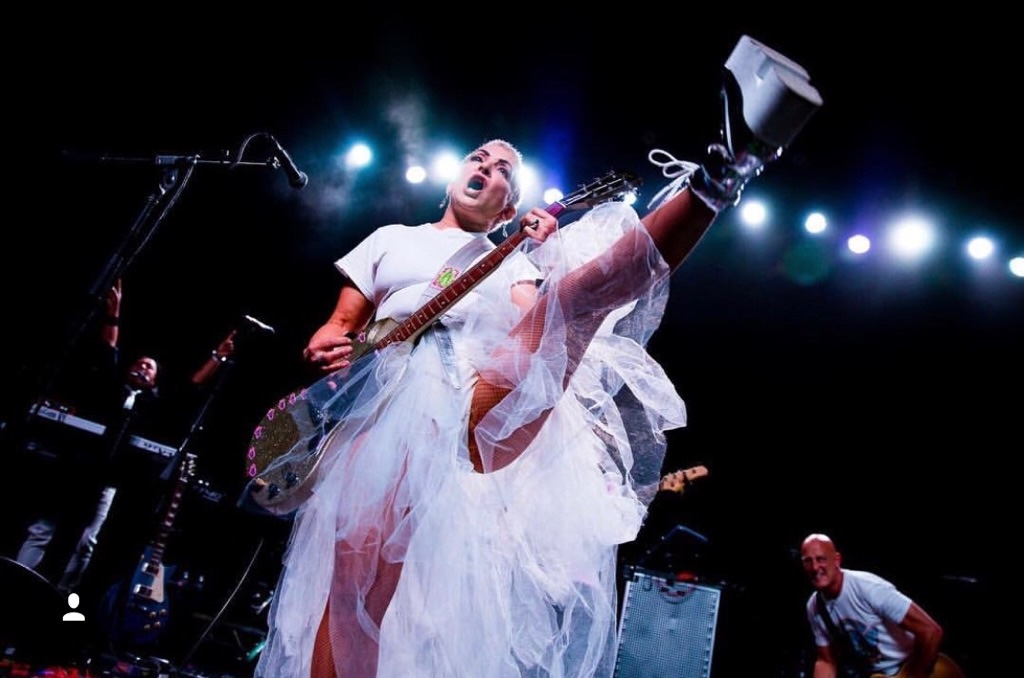
The first time I spoke to Jane Wiedlin, I made her cry. It wasn’t intentional. This was in 2020, around the release of her band’s documentary, The Go-Go’s. I interviewed each member separately and had written a little declaration that I read to them. It went like this: “Thank you for doing what you did and making it look effortless and attainable and not out of the ordinary for someone like me, who whether or not I wanted to be an artist, never for one second did I think that I couldn’t.” Jane and I were on the phone when I heard little whimpers. “Jane, are you crying?” I snapped, to which she replied in her sweet squeaky voice, “Yes.”
Today, my goal is to make her smile. “I’ve already cried once in an interview today,” she says. This puts me at ease in case it happens again. Having read her memoir, TMI: Memoirs of a Go-Go, I have a new understanding of the challenges she faced growing up, in the band and for years afterward. She’s the fourth Go-Go to write a memoir, and like her bandmates, she doesn’t hold anything back. The Go-Go’s were the first—and remain the only—all-female band to write and perform their own songs and reach No. 1. Their accomplishments were matched by their partying, which led to addiction for vocalist Belinda Carlisle, guitarist Charlotte Caffey and bassist Kathy Valentine.
Jane was no exception when it came to the band’s drug and alcohol use. As she writes in the book: “Drugs and booze became our daily—and nightly—go-tos. If you felt happy, you wanted to celebrate . . . with drugs and booze. If you were upset, you wanted to medicate . . . with drugs and booze. If you were tired . . . drugs and booze. If you were anxious . . . drugs and booze. If you needed to sleep . . . drugs and booze. If you needed to wake up . . . drugs and booze. And when you just wanted to escape when there was nowhere to run to, there were certainly drugs and booze.”
But she didn’t become an addict. Instead, TMI reveals her struggles with mental health, particularly bipolar disorder, which went undiagnosed well into adulthood. She attempted suicide twice, survived two sexual assaults, endured a series of unsuccessful relationships, some decidedly toxic, worked as an assistant to an established BDSM dominatrix, and country-hopped, changing residences as quickly as a short-term car lease.

“If you aren’t going to barf out all the dirty details and your bad behavior and stuff, I don’t really see the point of writing an autobiography,” she says.
None of this diminishes her exceptional songwriting talent. Jane and Charlotte wrote the majority of the Go-Go’s material. More importantly, it doesn’t lessen the significance of what she created with the band: the trail they blazed, the empowerment they gave young women, and their continuing commitment to speaking the truth. As Jane writes in TMI: “We get called bitches if we speak up, whores if we have sex, and pathetic has-beens if we dare to get older. We’re conceited if we look good and hags if we don’t. We’re emotional if we show feelings and mousy if we remain silent. Can you imagine if people spoke about guys this way? There’d be an awful lot of hysteria and mansplaining!”
Jane is speaking from a beautiful Los Angeles home belonging to friends. She lives in the Bay Area, but the place she’s sitting now is stunning. Black railings line a curved staircase behind her, topped by a wrought-iron chandelier. She’s wearing a black-and-white striped T-shirt, and her signature pixie cut is a lovely shade of purple. A bowl of lilac-colored flowers beside her complements her hair. As we talk, the sun moves across her face, and she simply glows. She’s 68-year-old goals for me, just as she was 18-year-old goals when I was a teenager.
Unlike Jane, I’m late to the protest game but she’s a longtime pro. She recounts her experience with imprisonment in TMI, so it’s hardly surprising that she’s now put together an album of protest song covers, I Protest. The song selection spans Muse’s “Uprising,” Yungblud’s “Machine Gun,” Bad Religion’s “American Jesus” and Cracker’s “Low,” with musical styles to match. Across the covers, Jane unleashes seven decades of pent-up anger and energy in a heady mix of piss and vinegar. I wasn’t expecting anything less.
Leading up to our conversation, I’ve overdosed on Jane. Besides reading TMI cover to cover, I’ve rewatched the Go-Go’s episode of VH1’s “Behind the Music,” which they all hate so much, and the official documentary. I’ve listened to the audiobook of John Doe’s Under the Big Black Sun: A Personal History of L.A. Punk, which includes a chapter on Jane, and watched parts of the early-’80s concert film Urgh! A Music War, featuring the young Go-Go’s performing at the Whisky a Go Go in Los Angeles. “I haven’t seen that since it came out,” Jane says. “How is it? Was it good?” I assure her it is and that they’re great in it.
“There has never been this much interest in me since the Go Go’s in the ’80s,” she says. “It’s shocking. I’m totally flattered and grateful, but it’s almost hard to believe.” I respond almost defensively, insisting, “You’re important to us Jane. You matter so much—and not just to my generation, to everyone that came after you.”
Then I decide to read her the declaration I shared six years ago. If she cries, so be it. She needs to hear it. So I do. When I’m finished, she says, “Thank you for that. I need to be reminded every once in a while.”

We’ve been waiting for your memoir for years. Why was now the right time for you?
Part of it was the clock ticking, but also what had spooked me is: How do I tell my story honestly without hurting anybody? That’s a big deal to me because I don’t want to hurt people. I finally feel like I struck a balance because I thought if I own all my mistakes, then it’ll be easier to tell everything truthfully, and that’s what I did. I like that it’s overly honest, hence the name TMI, because those are the kind of autobiographies that I really enjoy.
So many musicians have told me that because of punk, they felt like they could try to do music as they didn’t have to have training or be perfect. That was also the case with you?
Totally agree, but funnily enough, I listened to this tape today from 1979 at the Whisky, the first time that Kathy Valentine played with us. I thought it was going to be terrible, and I was shocked that we were very proficient. It was so much better than I thought it was going to be. I went into it not knowing anything, but I think everyone in the band fell in love with being in a band so we worked really hard to get better and better, and you can hear it in that show. In some ways, I played better then than I’m playing now because I haven’t played guitar in so long that when I pick it up, I can barely play.
When I interviewed Red Kross a few years back, Jeff McDonald [husband to the Go-Go’s Charlotte] told me their daughter is in the punk scene in L.A. and that it has very stringent expectations about rejecting negative behavior. That feels like a return to your early punk experiences.
It makes a lot of sense because the good people among us, we’ve all been striving over generations to become better people. I like to think that the punks of the latest generation, they’ve been raised right, and they know that being a dick isn’t cool anymore. I mean, it’s okay to punch fascists, as they say, but other than that, we should be kind to each other, especially in these very trying times.

a Boy or a Girl. (Credit: Christie Dieu)
How soon after Beauty and the Beat did things start to unravel for the band? In the book it feels like it was almost instant.
It took a while. The first year of that release we toured 300 days. There was a lot of unity at that time because we were really pushing hard, and we were all very determined to get our music out to the world, and attempt to be successful. After it happened, things started getting a little bit more difficult. I talk about that in the book, how I, especially, having never been in a band before, didn’t realize that once you get successful, the singer becomes the focus. The band members, it’s almost like they’re the backing band. That’s just the reality of the music business. But I didn’t know that. I mean, I didn’t notice that, even though I did the same thing with the bands I liked. That started getting difficult. Even though it wasn’t Belinda’s fault, it was situational, it made things more tense.
Compounded with that, after we came off the road, our record company said we needed a new second album right away, that we had less than two months to put it together. It’s that same old thing … they say that you have your whole life to do your first album and a couple months to do your second, hence the sophomore slump, which we definitely suffered from because we were grabbing songs that didn’t make the first album, or half-baked ideas and trying to cobble everything together. It’s not a bad album, but I always think it would be impossible to top Beauty and the Beat. It’s such a good album. The songwriting is so wonderful. It kind of eroded as time went on.
I never knew ’til recently that what I consider the best times of my life were before we got famous, like when I was a punk rocker when we first started the band. All that was so exciting and so hopeful. You’re thinking that the future is going to be so bright, and you’re naive, but so what? In the end, I got what I was hoping to get, which was fame and fortune. It just wasn’t what I thought it would be.
It never is.
So many famous people seem to handle it really well. They’re very graceful about it, and they have all the things. I’ve never felt like that person. I’ve never felt famous. I’ve always felt regular, probably because I’m from the Midwest and was raised Catholic. There was a lot of rules against thinking you were anything more than anybody else. Other people were able to embrace fame and be that way gracefully and not come off like a dick whereas I thought that would be the greatest sin in the world. It took me a really long time to become self-confident.

Why do you think you didn’t suffer from addiction the way the majority of your bandmates did?
It’s probably genetics. My parents barely drank. I never saw my parents drunk. I don’t know why it didn’t happen. Because I partied hard too, but also the aftermath of partying was always so brutal. Until you connect those two things in your mind, you’re probably not going to slow down. But it got to the point where I just couldn’t stand the way I felt. It was fun for the first hour last night, but at 6 o’clock in the morning, when you’re still up and you just want to stab yourself in the eyeballs, if you don’t have addiction problems, you’re going to change your ways quite a bit. So I did. Like I said in the book, it was really hard when I stopped partying and I was still in the band, and it was still the heyday. It got really difficult because that was sort of a bonding thing for us to do together, and when I wasn’t doing it, I felt like an outsider.
You were the only Go-Go to not want to participate in “Behind the Music” when the series approached you for an episode. How did you know to push back?
I don’t know that anyone else in the band had even watched that series. It was terrible and so formulaic. I don’t know if I ever saw a woman on that show before us, but it was always the same thing. They’re no longer famous. They’re no longer popular. They’re no longer cute and skinny, and they’re telling you that they just love this life so much more, being a plumber than being a rock star. And you’re kind of like, “Oh yeah, right.” I felt like the people that were being interviewed were disingenuous, and I felt like the questions were tricky, and there were traps. The whole thing was super ick. I tried and tried to tell the other women because I already knew by this time that I was the one that was the oversharer, and everyone else was very guarded. I said, “You’re not going to be happy with this because there’s a formula, and they’re going to do it. They’re going to show the rise. They’re going to show how terrible we acted and why we self-destructed ourselves. And then they’re going to show the end with your ‘husbands,’ and that’s going to be it.” They were like, “No, no, it’s going to be great.” And sure enough, it was exactly what I said it was. When I saw it, I didn’t care. I took it very lightly because I knew what was coming. Everyone else took it very hard, and everyone was very angry. And that’s why, for decades after that, all of us were “No way, never again. We’re not going to get tricked again.”

It felt like you were trying to show that you’re just as wild and crazy as the guys.
Not only that, but we were called America’s sweethearts for so long, and it really irked us because we were grown-ass adults, and we were not sweethearts. I think we’re all good people, but we were not America’s sweethearts. We were partying and we weren’t perfect. That caused us to push even harder in the other direction to prove to people, like you said, that we could party just as much as the boy bands. As it turns out, we could not, and we did not. Men are way more apt to get into really gnarly, icky situations than women are.
Your place you carved in music and the path you laid for other people is undeniable.
You’d be surprised how many people denied it for a really long time. We really had to raise our voices about this. I just want to point out, not only were we the first all-female band who wrote their own all their own songs, played all their own instruments, and went to No. 1 on the charts, we are still the last. There’s never been anyone that topped that. That’s the most shocking thing of all to me. Where the hell are they? Why can’t this happen again? It needs to happen more.
You’ve made a blistering protest album of covers, which you produced yourself.
It’s the first time I produced a record entirely on my own, and that was really fun. I didn’t realize that producers are at least as creative as musicians and writers, but what they have is musicians that are better than they are. The engineer was a good friend of mine. He’s absolutely amazing. It opened a whole new world for me of being creative. I never had such a pure joyful experience.
Has making this record inspired you to make more music?
No. Well, I’m trying to take one step at a time because if I start thinking into the future, I get nervous. Right now, I just want to tell people about my book and hope they read it, and I want to show people this music and hope they love it and hope they embrace the message, which is get out there and protest and do something.

It sounds like the album was a release for you. Was writing the book therapeutic for you?
It was. I made some weird connections just from writing it that hadn’t occurred to me. Like my suicide attempt at 15, until I wrote it all down, I didn’t even realize that the sexual assault thing had occurred not long before that. I know that sounds crazy that I wouldn’t have noticed that, but I did after I wrote it all down.
That doesn’t sound the least bit crazy. When things like that happen, you diminish them to make them manageable and even be able to convince ourselves that it didn’t happen to us.
Yeah, or if it did happen, it wasn’t a big deal, and it was my fault. That’s kind of how I felt about it for a really long time until the Me Too movement, and then I realized, oh shit, it’s not my fault that I couldn’t speak out and say no, or that I couldn’t fight back. It’s not my fault. I was a kid, and I was scared and I have been taught that men’s opinions mean everything, and my opinions mean nothing. My parents were well-meaning, but that was how it was in those days for a lot of us.
What you share about your relationships in the book, although through a rock star lens, are very relatable.
I always had a boyfriend. I’ve always been one of those people that walk out the door of one boyfriend and into the door of the next. I think there’s been men that glommed onto me because they thought I was a rich celebrity. If that’s why they like you, that never works out of course. I’ve been single now for over three years, and as I get older, I get less and less tolerant. My space has to be just how I want it and it’s not consistent. Like I want my kitchen to be clean, but if I’m too tired to do the dishes tonight, it can wait till morning. But if it’s another person, then that’s a different story. I wasn’t ever good at being alone. This new chapter of my life is an experiment, and I’m learning a lot. I’m finally starting to sort of embrace it and I’m proud of myself for doing it. We all know the statistics: happiest people out of every group are older single women, every time.