
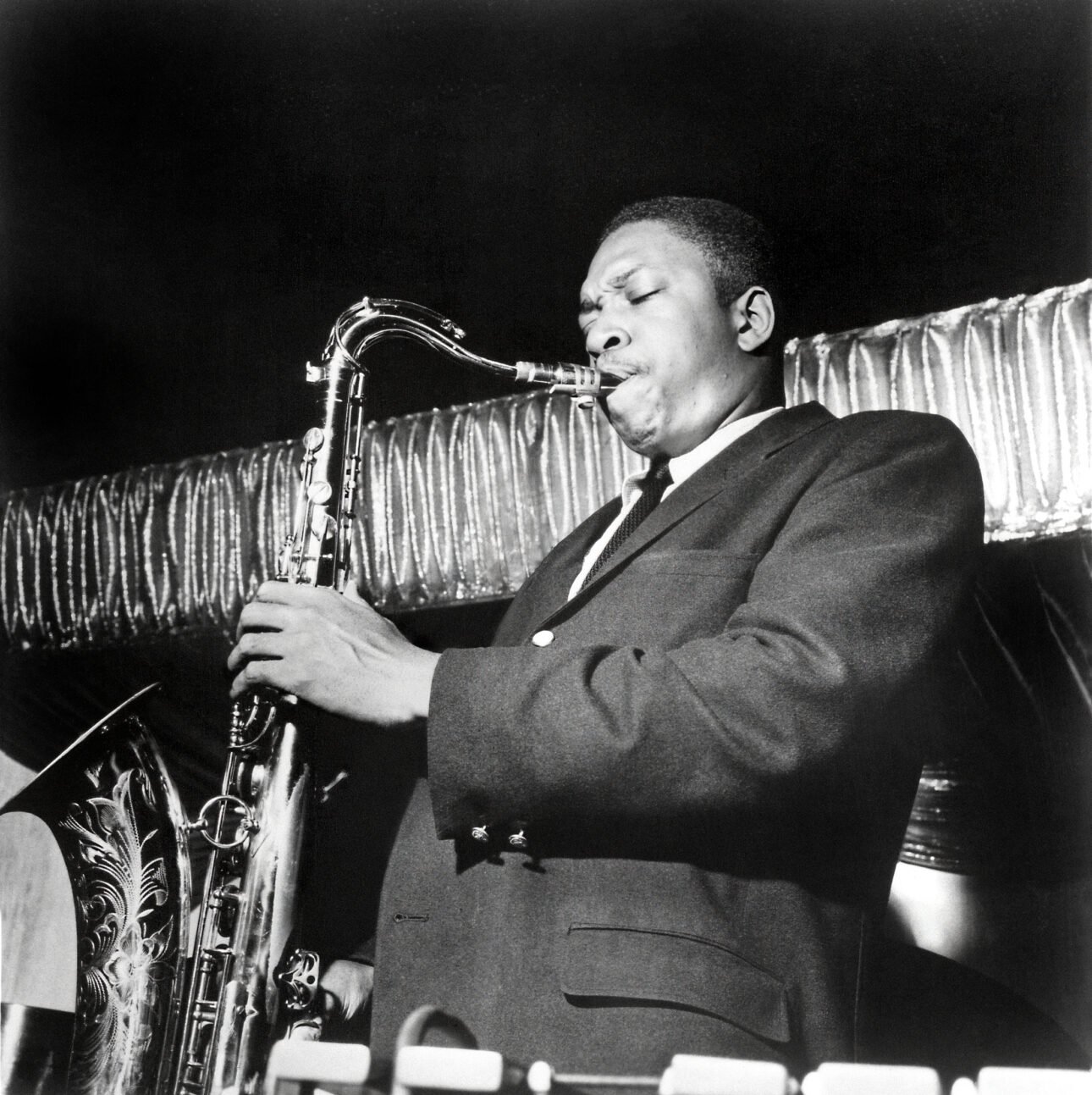
On what would have been John Coltrane’s 100th birthday, Impulse! Records is opening another door into the saxophonist’s endlessly expanding musical universe. The Tiberi Tapes: The First Studio Recording will arrive Nov. 6, collecting 11 selections drawn from private recordings made by saxophonist Frank Tiberi in New York and Philadelphia beginning in 1960. The tapes, which have circulated largely as jazz world lore for more than six decades, capture Coltrane performing in clubs during a crucial period of his artistic development.
The collection will be available as a four-LP set, three-CD set and digitally. A limited hand-numbered edition of The Tiberi Tapes: The Complete Recordings is also planned for early 2027, containing more than 80 performances and nearly 26 hours of audio on a custom USB drive, alongside an LP and deluxe book.
For a musician whose recorded legacy has already been mined from seemingly every possible angle, the Tiberi archive offers something different: Coltrane in the room, working things out in real time. As SPIN noted in its recent centennial survey of Coltrane’s career, some of the most revealing moments in his enormous catalog can be found away from the obvious landmarks — small gestures and unexpected turns that emerge when you listen closely. The Tiberi Tapes take that idea literally, preserving performances made not as commercial releases but as a musician’s private study materials.
Tiberi began making the recordings after becoming fascinated by what Coltrane was doing onstage. He already owned the saxophonist’s records, but the club performances sounded different to him. “I had all of them,” Tiberi recalls in an essay by music historian Ashley Kahn. “To me they were not anywhere near the kind of playing and inspiration that he would display at a club.”
So in the summer of 1960, Tiberi bought a Concertone TR-100 Transicorder, a portable reel-to-reel recorder with a small condenser microphone, and began carrying it to Coltrane performances. He recorded from the audience, sometimes running the microphone beneath his coat or placing it near a speaker, and learned to change the machine’s tiny three-inch reels by touch as Coltrane stretched performances beyond what the equipment could comfortably accommodate. “My main purpose of recording him was to really, to get information and harmonic values, so that I could be able to really play myself,” Tiberi says.
The resulting archive eventually grew to more than 80 reels containing over 26 hours of music from dozens of performances in Philadelphia and New York. Documentation was inconsistent — some reels were dated, some weren’t, and musicians weren’t always identified — but the recordings became a kind of secret history of Coltrane’s development. They also became increasingly mythical, as word of the tapes spread among saxophonists, students, collectors and Coltrane obsessives. A select number of musicians were allowed to sample portions of the archive, but the vast majority of listeners could only hear about what was supposedly on those reels.
Now, for the first time, the public will get an official selection. However, the recordings aren’t pristine, as they were made with modest consumer equipment in crowded clubs, and the balance can favor Coltrane’s saxophone and the drums while leaving bass and piano comparatively recessed. But that’s also precisely what makes them valuable. In a 1961 conversation with critic Ralph Gleason, Coltrane himself drew a distinction between the studio and the club. Some of his best performances, he said, had happened “on the job.” The club recordings, he suggested, might not have sounded better in terms of reproduction, “but as far as the feeling of it.”
The 11 selections include two versions of “Giant Steps,” performed at dramatically different tempos (226 and 262 BPM) along with “Thing in D Flat,” “Lover,” “West 42nd St.,” “Impressions,” an untitled F-minor piece, “Satellite,” “Good Bait,” “Resolution” and “It’s Easy To Remember.”
“Giant Steps,” in particular, offers a tantalizing glimpse of Coltrane grappling with material that would become one of the defining statements of his harmonic ambition. Elsewhere, the tapes preserve Coltrane searching through standards and developing ideas in the moment, rather than presenting the finished versions that history has canonized.
The release is part of the year-long COLTRANE 100 celebration surrounding the saxophonist’s centennial. Impulse! is also marking the occasion with Chasin’ the Trane: Copenhagen 1962, a Verve Record Club exclusive featuring Coltrane’s classic quartet with McCoy Tyner, Jimmy Garrison and Elvin Jones, as well as Essential John Coltrane, a two-LP collection of more familiar material.